He Saved a Police Officer. Then They Handcuffed Him Again. What Happened Next?
The handcuffs clicked shut.
Just minutes earlier, a prisoner had been walking down an empty street, his wrists finally free.
Now he stood between two police officers, his hands restrained once again.
But he wasn’t looking for another chance to run.
He was looking toward the ambulance.
“Is he okay?”
One of the officers hesitated.
“He’s…”
What came next was something the prisoner had never expected.
The following is a fictional continuation inspired by the video. The original footage ends with the prisoner being handcuffed again.
A Chance at Freedom
It had all happened so quickly.
The police officer suddenly collapsed beside his patrol vehicle, clutching his chest before falling onto the pavement.
The prisoner saw the keys hanging from the officer’s belt.
Within seconds, he had unlocked his handcuffs.
The street was empty. Nobody was chasing him. There was nothing physically stopping him from walking away.
And for a moment, that was exactly what he did.
But after taking several steps, he stopped.
He looked back.
The officer was still lying motionless beside the vehicle.
The prisoner turned around and ran back.
The Decision That Changed Everything
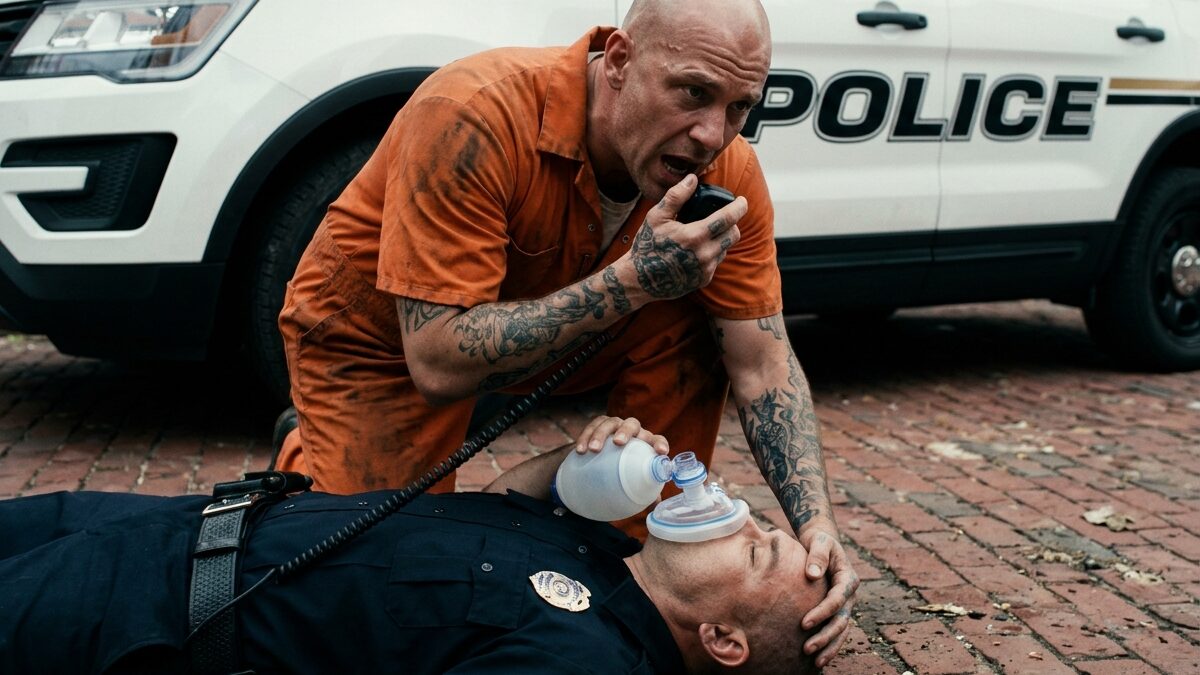
He knelt beside the fallen officer, supported his head and tried to help him breathe using a small breathing aid.
Then he reached for the police radio.
“We need an ambulance! Hurry!”
He remained beside the officer until emergency responders arrived.
As the medical team moved the officer toward the ambulance, two other police officers approached.
“Hands forward, please.”
The prisoner quietly obeyed.
He didn’t struggle. He didn’t argue. He simply held out his wrists.
The metal handcuffs closed again.
But before the officers led him away, he asked one question.
“Is he okay?”
The Answer He Had Been Waiting For
The officer standing in front of him finally answered.
“He’s alive. The medical team is doing everything they can.”
The prisoner closed his eyes for a brief moment.
“Thank God.”
For the first time since the incident began, he seemed to relax.
He had given up his opportunity to escape.
But knowing the officer still had a chance to survive was enough.
Or so he thought.
Three Days Later
In this imagined continuation, the injured officer woke up in a hospital room.
His colleague was sitting beside the bed.
“What happened?” the officer asked weakly.
“You collapsed beside your vehicle. The ambulance got you here in time.”
The officer frowned.
“And the prisoner?”
His colleague hesitated.
“He got your keys. He unlocked his cuffs.”
The injured officer stared at him.
“Then how did you catch him?”
“We didn’t chase him. He came back.”
The room fell silent.
“He helped you until the ambulance arrived. Then he let us handcuff him again.”
The officer slowly turned his head toward the window.
After a long silence, he asked:
“Where is he now?”
The Meeting Nobody Expected
Several days later, the officer arranged to speak with the prisoner.
The two men stood facing each other.
For a moment, neither knew what to say.
Finally, the officer broke the silence.
“You could have escaped.”
“I know.”
“Nobody was stopping you.”
“I know.”
“Then why did you come back?”
The prisoner looked down at his hands.
“Because you were lying there. And you needed someone.”
The officer remained silent.
The prisoner continued.
“I thought about leaving. I really did. But I couldn’t live with knowing I walked away and left you there.”
The officer took a slow breath.
“You may have saved my life.”
The prisoner said nothing.
Then the officer extended his hand.
“Thank you.”
For a few seconds, they were no longer simply an officer and a prisoner.
They were two people connected by a decision neither would forget.
Did the Prisoner Finally Get His Freedom?
The officer could not erase the prisoner’s past.
He could not promise to change his sentence or guarantee his release.
But he could make sure the prisoner’s actions were officially documented and that the people responsible for his case knew what had happened.
The prisoner remained in custody.
There was no miraculous pardon. No instant release.
Yet the officer made one thing clear before leaving.
“Whatever happens next, I won’t forget what you did.”
The prisoner nodded.
“Just take care of yourself, Officer.”
And with that, their meeting ended.
The Choice That Mattered Most
Some people might look at this story and see a man who missed his chance at freedom.
Others might see something entirely different.
The prisoner had an opportunity to walk away.
Instead, he turned around to help someone who could not help himself.
He didn’t know whether anyone would thank him.
He didn’t know whether his actions would change his future.
And he certainly didn’t know whether the officer would survive.
He simply knew that someone needed help.
He could have chosen freedom for himself. Instead, he chose to give another man a chance to live.
And sometimes, the greatest measure of a person isn’t what they do when everyone is watching.
It’s what they choose when they could easily walk away.
Editor’s note: This story is a dramatized fictional continuation. The source video shows the prisoner returning to assist the fallen officer, emergency responders arriving, and officers placing the prisoner back in handcuffs. The hospital recovery, subsequent conversations and later outcomes are fictional and are not verified by the footage.