He Chased Her for Stealing Bread—Then Saw Why
A baker thought he was chasing a thief. But what he discovered on the sidewalk made him see the situation very differently.
It started inside a small neighborhood bakery.
A woman wearing an old, faded green coat hurried through the glass entrance. She looked exhausted, and her attention went straight to a tray filled with freshly baked bread.
Without approaching the counter to pay, she grabbed two round bread rolls.
Then, almost immediately, she took a bite from one.
But she wasn’t alone.
The baker had just stepped out through the kitchen doors.
He noticed the woman standing beside the bread display. His expression changed, and he pointed toward her.
Startled, she clutched the bread against herself and ran toward the exit.
The baker rushed after her.
A Chase That Ended Somewhere Unexpected
The woman ran along the city sidewalk, still holding the bread.
The baker followed close behind.
From his perspective, someone had entered his business, taken food without paying, and fled.
He had no idea where she was going.
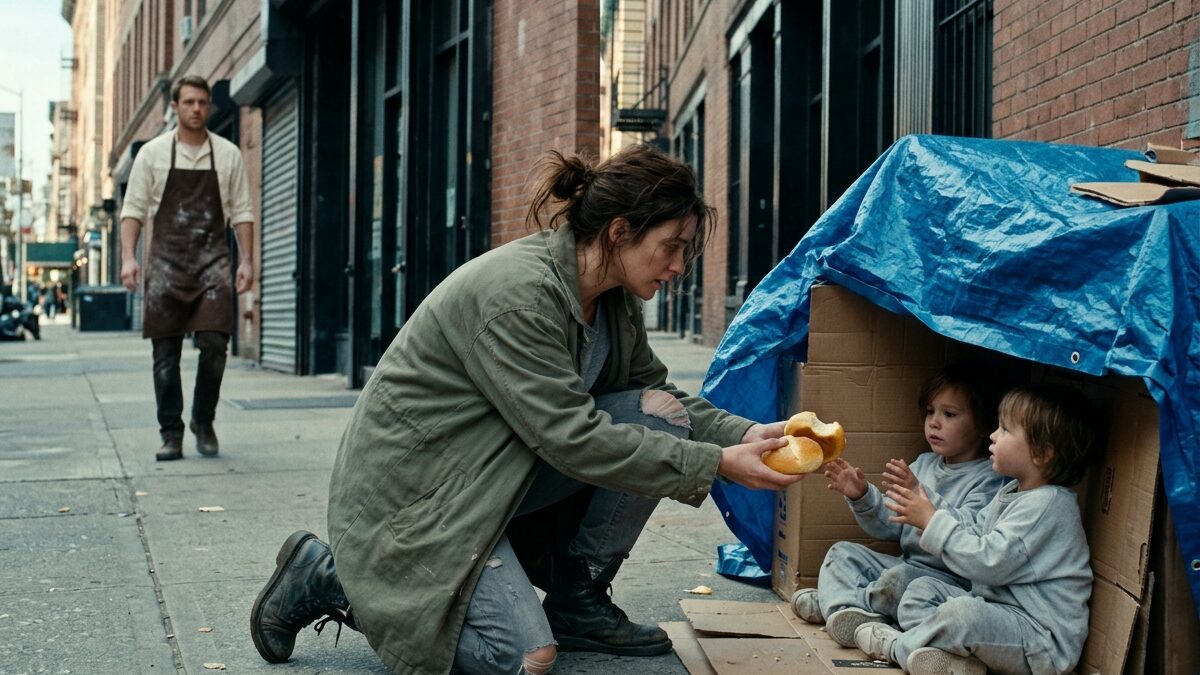
But instead of continuing down the street, the woman suddenly stopped beside a building.
Against the wall stood a simple shelter covered with a large blue tarp. Cardboard boxes were stacked nearby, and flattened pieces of cardboard lay across the ground.
Two children were sitting there.
The woman immediately knelt in front of them.
Then she held out the bread she had taken.
The children looked up at her and reached for the rolls.
The baker arrived just as she was sharing the food.
And suddenly, everything looked different.
The Moment That Changed His Reaction
The baker stopped.
He looked at the woman, then at the two children sitting beside the blue shelter.
Only moments earlier, he had been angry.
Now he was watching the woman give the bread to two children who had been waiting for her.
She had eaten some herself, but she had also carried the food directly to them.
The baker’s expression softened.
For a moment, he stood silently, taking in the scene.
Then he turned around.
The woman remained beside the children.
What happened next was something she could hardly have expected.
He Returned to the Bakery—But Not to Forget
The baker walked back into his shop.
He went toward the bread display and brought out a cardboard box.
Then he began filling it.
One fresh bread roll after another went into the box until he had gathered a generous supply.
He lifted the box in his arms and headed back outside.
This time, he wasn’t following the woman to confront her.
He was returning to help.
A Box Full of Kindness
When the baker reached the blue shelter again, the woman and the two children were still there.
He stepped toward them, carrying the box.
Then he offered it to the woman.
Inside were fresh bread rolls from his own bakery.
The woman reached out and accepted the gift.
Her expression showed how deeply the unexpected gesture affected her.
The children smiled.
And the baker smiled with them.
What had begun with anger inside a bakery ended with a moment of generosity on the sidewalk.
He could not change the difficult circumstances he had witnessed.
But he could choose how to respond.
And in that moment, he chose compassion.
The Lesson Behind This Story
Taking something without paying is not the right way to solve a problem.
But this story also reminds us that a single action does not always reveal the whole situation.
The baker initially saw someone taking bread from his business.
Only after following her did he discover the two children waiting beside the shelter.
That discovery changed his response.
Instead of allowing the confrontation to end in anger, he offered something more meaningful: food freely given.
Sometimes, understanding another person’s circumstances does not require us to excuse what happened.
It simply gives us the opportunity to respond with greater humanity.
Because sometimes, the most powerful act of kindness begins the moment we look beyond our first judgment.