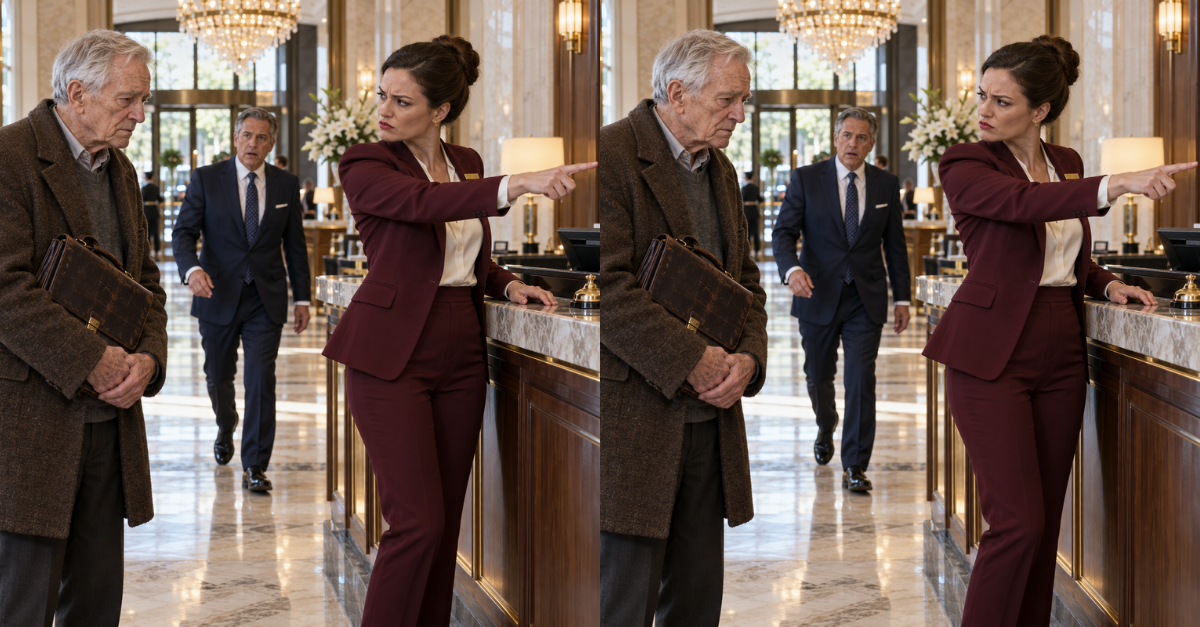
Arthur stood beneath the hotel’s crystal chandelier with both hands wrapped around the handle of a battered leather briefcase.
For a moment, he forgot the ache in his knees.
The staircase was still there.
So were the tall windows overlooking the street, although the walnut reception desk had replaced a smaller oak counter he remembered helping carry through the doors.
“Can I help you?”
The woman approaching him wore a burgundy suit and an expression that suggested she already wanted him gone.
“I was hoping to look around,” Arthur said.
Vanessa’s eyes traveled from his worn shoes to the frayed cuffs of his brown coat.
“Are you a guest?”
“No.”
“Do you have a reservation?”
Arthur shook his head.
She pointed toward the entrance.
“We don’t serve beggars. Leave.”
A young receptionist looked up. Near the elevators, a couple stopped talking.
Arthur tightened his grip on the briefcase.
“I haven’t asked you for anything.”
“Then there’s no reason for you to be here.”
He looked past her toward the staircase.
“I only wanted to see it again.”
Vanessa reached for the radio clipped behind the reception desk.
Arthur lowered his briefcase onto a nearby table. The brass clasp opened with a small click.
Inside lay a photograph protected between two pieces of cardboard.
He had carried it for forty-three years.
“Perhaps someone might remember—”
“Put that away.”
“Vanessa?”
A man in a navy suit approached from the corridor behind reception.
Richard, the hotel’s director, glanced at Arthur, then at the photograph in his hand.
“What’s happening?”
“This gentleman refuses to leave,” Vanessa replied. “I’m handling it.”
Richard was about to speak when he noticed the briefcase.
Its brass clasp had been repaired with a narrow strip of silver metal. Beneath the handle was an embossed symbol: a small oak tree inside a circle.
His father had drawn that symbol on everything.
Business stationery. Birthday cards. The first sign outside the hotel.
Richard stepped closer.
“Where did you get that briefcase?”
Arthur studied his face.
Then he unfolded the photograph.
Two young men stood outside the unfinished hotel. One held a roll of architectural drawings. The other had his arm thrown around his friend’s shoulders.
Arthur pointed to the second man.
“Your father gave it to me.”
Richard took the photograph carefully.
He recognized his father immediately.
The other man was thinner now, older by decades, but the eyes were unmistakable.
“You’re Arthur.”
Arthur nodded.
“My father used to talk about you.”
“Did he?”
“He said you could look at an empty building and tell him where people would feel at home.”
Arthur’s mouth trembled.
“That sounds like Edward.”
Vanessa lowered her radio.
“Mr. Bennett, I didn’t realize—”
“Please give us a moment,” Richard said.
He guided Arthur toward a quiet table beside the windows.
“Can I get you some tea?”
“Yes,” Arthur said. “Thank you.”
Richard sat opposite him.
“I thought you sold your share and moved away.”
“I did.”
“Dad never explained why.”
Arthur looked down at the photograph.
“My wife became ill just before the hotel opened. There were treatments we couldn’t afford. Your father bought my share so I could take her closer to a specialist.”
Richard waited.
“She died the following spring.”
“I’m sorry.”
Arthur nodded once.
“After that, I couldn’t bear this place. We’d chosen the curtains together. She’d planted flowers in boxes outside while we were still laying the floors.”
He glanced toward the entrance.
“Coming back felt like walking into the life we were supposed to have.”
“Dad tried to find you.”
“He wrote. I answered once or twice. Then I stopped.”
Arthur rubbed a thumb along the briefcase handle.
“I kept meaning to come when it hurt less. Somehow, forty years passed.”
Richard’s father had died six months earlier.
Arthur had learned about it from an old newspaper at the public library.
“I’m not here about money,” he added quickly. “Your father paid me fairly. I only wanted to know whether any of what we built was still here.”
Richard looked around the lobby.
“Come with me.”
He took Arthur to a small meeting room overlooking the courtyard.
Above the fireplace hung an original drawing of the hotel. In the bottom corner were two signatures.
Edward Bennett.
Arthur Collins.
“My father wouldn’t let anyone replace this,” Richard said.
Arthur stood before it for a long time.
Then he touched the glass with two fingers.
Outside the room, Vanessa waited.
When Richard returned, she began explaining that she had been protecting the hotel’s standards.
He stopped her.
“You called a man a beggar because of his clothes.”
“I didn’t know who he was.”
“You didn’t need to.”
Her expression changed.
Richard asked her to step away from reception and informed her that her conduct would be formally reviewed. He also spoke with the receptionist who had witnessed the exchange.
Arthur was offered an apology before he left. He accepted it quietly, without pretending it erased what had happened.
A week later, Richard invited him back to help identify people in the hotel’s early photographs.
Arthur arrived with the same coat and briefcase.
This time, he brought handwritten notes.
Over the following months, they assembled a small display about the hotel’s beginnings. Arthur insisted that the builders, cleaners, kitchen workers, and his late wife be named alongside its founders.
At the opening, Richard asked whether he wanted a newer case for his papers.
Arthur glanced at the worn leather beside his chair.
“No, thank you.”
He rested his hand on the handle.
“This one still does its job.”