Hotel Manager Kicked Out a Poor Old Man… Then Discovered He Was the Hotel’s Founder!
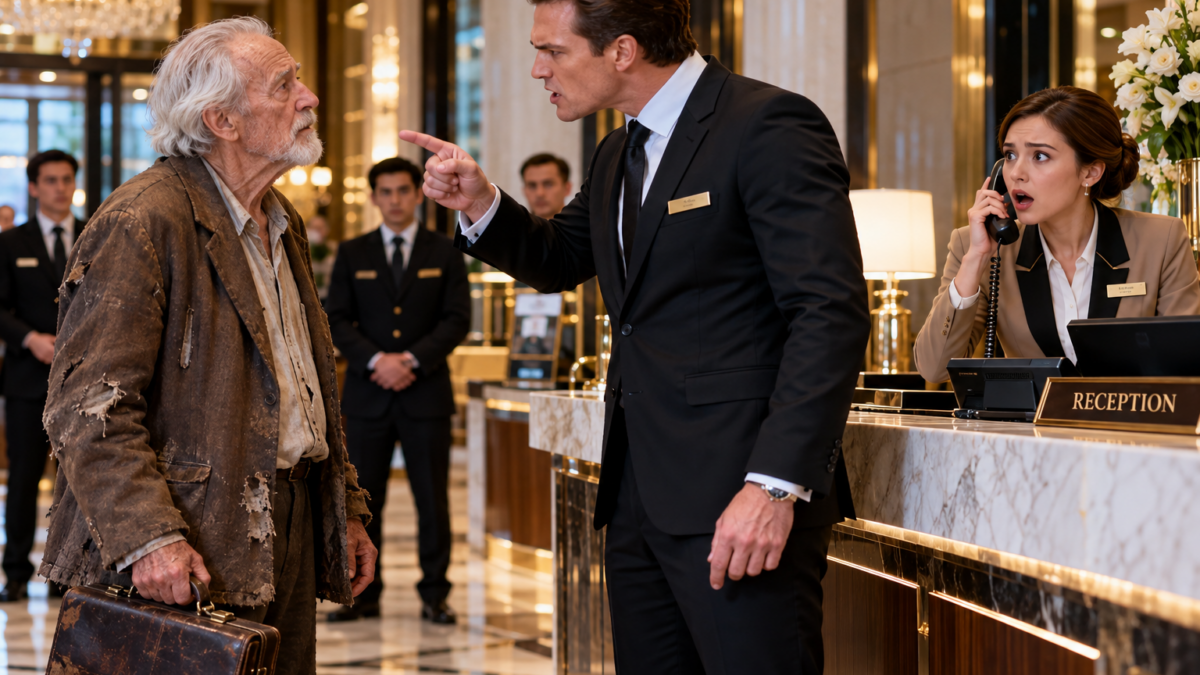
An elderly man wearing a torn brown jacket walked into a magnificent five-star hotel, carrying an old leather briefcase. Before he could explain why he was there, the arrogant general manager stopped him.
“This is a luxury hotel, not a shelter. Leave immediately before I call security.”
The old man didn’t argue.
But a young receptionist recognized his face. She immediately picked up the telephone and made an urgent announcement.
“Emergency at the main lobby. The founder is here.”
What happened next left the entire hotel speechless.
An Old Man Walked Into a Palace of Luxury
The grand hotel lobby looked like something out of a royal palace.
Massive crystal chandeliers hung from a towering ceiling.
Cream-colored marble columns rose toward intricate golden decorations.
An enormous staircase with dark wrought-iron railings swept upward behind the polished reception area.
The floor was made of gleaming white marble, decorated with elegant brown and black geometric patterns.
Well-dressed guests moved through the lobby.
Employees in immaculate uniforms stood behind dark walnut reception counters.
Everything looked expensive.
Everything looked perfect.
Then the revolving glass entrance turned.
And an elderly man stepped inside.
His name was Arthur Bennett.
He was 73 years old.
His silver-white hair was brushed back, revealing a forehead covered in deep wrinkles.
His face was narrow and weathered.
A short gray-white beard covered his chin.
His tired blue-gray eyes looked quietly around the enormous lobby.
He wore an old mud-brown jacket with small tears along the sleeves.
His beige shirt was faded.
His trousers were creased.
And his leather shoes were badly scuffed.
In his left hand, he carried an old dark-brown briefcase with worn brass buckles.
He looked like a man who had traveled a long way without much money.
But Arthur seemed strangely calm.
He stopped near the center of the marble floor.
He looked up at the chandeliers.
Then toward the grand staircase.
A faint smile crossed his face.
There was something familiar about the place.
Something deeply personal.
But before he could take another step, someone approached him.
“This Is a Luxury Hotel, Not a Shelter!”
Richard Cole was 38 years old.
He was the hotel’s general manager.
Tall, clean-shaven, and impeccably dressed, Richard wore a tailored black suit, a crisp white shirt, and a perfectly knotted black tie.
His dark hair was carefully slicked back.
His shoes gleamed beneath the lobby lights.
Richard took his appearance very seriously.
He believed the hotel should project wealth, exclusivity, and perfection at all times.
And when he noticed Arthur’s torn jacket and old briefcase, his expression hardened.
He walked directly toward the elderly man.
“Excuse me,” Richard said sharply.
Arthur turned toward him.
“Good morning.”
Richard looked him up and down.
His eyes lingered on the frayed sleeves.
Then the old shoes.
Then the battered briefcase.
“Can I help you?”
Arthur smiled politely.
“Yes. I was hoping to speak with someone about the hotel.”
Richard frowned.
“Do you have a reservation?”
“No, I don’t.”
“Are you expecting someone?”
“Not exactly.”
Richard folded his arms.
To him, the situation was obvious.
He assumed Arthur was a homeless man who had wandered into the wrong building.
Several guests nearby glanced in their direction.
Richard grew impatient.
Then he raised his voice.
“THIS IS A LUXURY HOTEL, NOT A SHELTER. LEAVE IMMEDIATELY BEFORE I CALL SECURITY.”
The words echoed through the marble lobby.
Arthur stood still.
His expression changed.
Not to anger.
Not to fear.
But to quiet disappointment.
He looked at Richard for several seconds.
Then he glanced toward the reception desk.
What Richard didn’t know was that somebody else had been watching the entire exchange.
The Receptionist Who Recognized Him
Emily Parker was 29 years old.
She worked at the hotel’s reception desk.
Her chestnut-brown hair was arranged in a neat bun, and she wore a camel-beige blazer with black satin lapels.
Emily had worked hard to earn her position.
She was known among her colleagues for being attentive, patient, and respectful.
Whether a guest arrived in a luxury car or carrying an old suitcase, Emily tried to offer the same professional welcome.
She had been arranging paperwork behind the counter when Arthur entered the lobby.
At first, she hardly noticed him.
Then she looked at his face.
Her hands stopped moving.
She recognized the silver-white hair.
The blue-gray eyes.
The shape of his face.
And the quiet expression she had seen many times in an old company photograph.
Emily looked again.
Her heart began racing.
No. Could it really be him?
She glanced toward Richard.
The general manager was standing directly in front of the elderly visitor, ordering him to leave.
Emily knew she had to act.
She reached for the black corded telephone on the reception counter.
Her fingers trembled slightly.
She lifted the receiver.
Then she spoke urgently.
“EMERGENCY AT THE MAIN LOBBY. THE FOUNDER IS HERE.”
Richard turned.
“What did you just say?”
But Emily wasn’t looking at him.
She was looking at the elderly man.
Because she knew something Richard did not.
The man wearing the torn brown jacket was Arthur Bennett, the original founder and current owner of the hotel.
The Black Card With the Golden Crest
Arthur slowly reached into the inside pocket of his old jacket.
Richard watched him suspiciously.
The elderly man removed a small rectangular object.
It was a matte-black metal card.
At its center was an elegant gold laurel crest.
Arthur held it between his thumb and index finger.
Then he raised it toward the manager.
Richard stared at the card.
His expression changed.
The hotel’s founder identification.
A symbol recognized by senior management and authorized employees.
Richard looked from the card to Arthur’s weathered face.
And suddenly, he understood.
The elderly man standing in front of him was not an unwanted visitor.
He was the person who had built the entire business.
The man whose company owned the magnificent building.
The man whose name appeared in the hotel’s founding records.
Arthur Bennett.
Richard took a small step backward.
His face went pale.
“Sir…”
Arthur said nothing.
He simply held the card for another moment.
Then lowered it.
Behind them, employees began gathering near the revolving entrance.
Two security officers approached, not to remove Arthur, but to respectfully acknowledge his arrival.
Other hotel staff recognized him.
A few began applauding.
Richard lowered his head.
The words he had spoken only moments earlier were still hanging in the air.
“This is a luxury hotel, not a shelter.”
Now those words had become the most humiliating mistake of his career.
“You’re Terminated.”
Arthur looked directly at Richard.
His voice was calm.
Firm.
And unmistakably authoritative.
“YOU’RE TERMINATED.”
Richard’s shoulders dropped.
“Mr. Bennett, please. I didn’t recognize you.”
Arthur studied him.
“That’s exactly what troubles me.”
Richard swallowed.
“I thought—”
“You thought what?” Arthur asked.
Richard looked down at the floor.
Arthur continued.
“You saw an old man wearing worn-out clothes.”
“You didn’t know whether he had a reservation.”
“You didn’t know whether he needed assistance.”
“You didn’t even know his name.”
Richard remained silent.
Arthur shook his head.
“And you decided he was unworthy of entering this hotel.”
The surrounding employees listened closely.
Then Arthur turned toward Emily.
The young receptionist stood nearby, visibly nervous.
He gestured toward her.
“I’m promoting the receptionist.”
Emily’s eyes widened.
Arthur continued.
“She recognized the true owner.”
For a moment, Emily couldn’t speak.
Then she placed a hand over her chest.
“Thank you, sir.”
The employees applauded.
Richard stood silently in his immaculate black suit.
Arthur stood beside him in his old, torn brown jacket.
And the contrast between them could not have been clearer.
But this wasn’t the entire story.
Because Arthur’s decision to visit the hotel dressed like an ordinary elderly traveler had a reason.
And it began many decades earlier.
Forty-Five Years Earlier: A Young Man With Almost Nothing
Long before Arthur became the owner of a luxury hotel company, he had been a young man struggling to survive.
He grew up in a modest household.
His father worked in a warehouse.
His mother cleaned offices in the evening.
Money was always tight.
Arthur learned early that life could be difficult for people who didn’t have connections or financial security.
When he was eighteen, he found work at a small roadside hotel.
It wasn’t glamorous.
The building was old.
The rooms were simple.
And the furniture needed constant repairs.
Arthur’s first job was carrying luggage.
He helped guests move their bags upstairs.
He cleaned hallways.
He delivered fresh towels.
Sometimes, when another employee was absent, he helped wash dishes in the kitchen.
The work was exhausting.
His uniform was secondhand.
His shoes had holes in the soles.
But Arthur never complained.
He wanted to learn.
And he dreamed that someday, he might manage a hotel of his own.
Not because he wanted crystal chandeliers or expensive furniture.
But because he loved the idea of making travelers feel welcome.
The Night Someone Treated Arthur Like He Was Worthless
One evening, Arthur arrived at work wearing an old jacket over his uniform.
It was raining heavily.
His shoes were wet.
And his clothes looked shabby after the long walk from the bus stop.
A wealthy guest entered the lobby.
The man noticed Arthur standing near the front desk.
He looked at the young worker’s worn clothes.
Then he turned toward the receptionist.
“Why do you allow people like that inside?”
Arthur froze.
He tried to explain that he worked there.
But the guest waved him away.
“Get him out of here.”
The hotel supervisor approached.
For a moment, Arthur feared he would lose his job.
But the supervisor did something unexpected.
She stood beside him.
And said:
“This young man is one of our hardest-working employees.”
Then she turned toward the guest.
“Everyone who enters this building deserves to be treated with respect.”
Arthur never forgot that moment.
For the first time, someone had defended his dignity when he had little power to defend himself.
Years later, those words became the foundation of how he wanted to run his own business.
How Arthur Built the Grand Hotel
Arthur worked in hospitality for years.
He learned how to handle reservations.
How to resolve guest complaints.
How to maintain rooms.
How to manage staff.
And, most importantly, how to make people feel welcome.
He saved money carefully.
He studied business in the evenings.
Eventually, he and a small group of investors purchased an aging hotel that was struggling to attract customers.
Arthur helped renovate it.
He focused on cleanliness, thoughtful service, and employee training.
The hotel slowly became successful.
Years passed.
Arthur reinvested his earnings.
The business expanded.
Eventually, he established a small hotel company.
Then a larger one.
And decades after carrying luggage in worn-out shoes, Arthur opened the magnificent five-star hotel whose chandeliers now sparkled above him.
It was the proudest achievement of his career.
But there was one principle he insisted every employee understand.
Every person who walked through the doors deserved dignity.
Not only wealthy guests.
Not only celebrities.
Not only important business travelers.
Everyone.
Arthur believed luxury should describe the quality of service, not determine who was worthy of receiving it.
Over time, however, the company grew.
New managers were hired.
New policies were introduced.
Arthur gradually stepped back from daily operations.
And he began to wonder whether the values that built his business were still being practiced.
Why the Founder Arrived in Old Clothes
Several weeks before his visit, Arthur received a letter from an elderly traveler.
The man explained that he had entered the hotel to ask about a room.
He had been wearing an old coat.
A staff member had looked at him suspiciously and spoken rudely.
The traveler had left feeling humiliated.
He had not filed a formal complaint at the time.
But he wanted the owner to know what had happened.
Arthur read the letter twice.
He remembered his own experience as a young hotel worker.
The worn shoes.
The embarrassment.
The feeling of being judged before anyone knew who he was.
He requested a review of the hotel’s guest-service practices.
The reports suggested that some employees had begun treating customers differently based on their appearance.
Arthur was concerned.
So he decided to visit personally.
He didn’t announce his arrival.
He didn’t send a luxury car.
He didn’t bring an entourage.
Instead, he chose an old jacket and carried the leather briefcase he had owned for years.
He wanted to experience the hotel without special treatment.
And he wanted to discover whether an elderly traveler who appeared to have little money would still receive a respectful welcome.
He had hoped the answer would be yes.
But Richard had answered that question within seconds.
The Manager’s Biggest Mistake
Back in the grand lobby, Richard tried to apologize.
“Mr. Bennett, I assure you this was a misunderstanding.”
Arthur looked at him.
“Was it?”
Richard hesitated.
“I didn’t know it was you.”
Arthur nodded slowly.
“Would your behavior have been acceptable if I were someone else?”
Richard opened his mouth.
Then closed it.
Arthur continued.
“Suppose I really were a man who had nowhere to stay.”
“Suppose I’d spent my last money traveling here.”
“Suppose I simply needed to ask the price of a room.”
He paused.
“Would I deserve to be humiliated?”
Richard said nothing.
Arthur looked toward the employees.
“This hotel’s purpose is hospitality.”
He gestured toward the grand staircase.
“We built this place so people could feel welcome.”
Then he looked at Richard again.
“And you turned that welcome into something only certain people could afford.”
Richard lowered his eyes.
Arthur’s voice softened.
“The problem wasn’t that you failed to recognize the owner.”
“The problem was that you failed to respect a human being.”
Why Emily Deserved the Promotion
After the confrontation, Arthur invited Emily to a quiet meeting.
She was still surprised by his announcement.
“Mr. Bennett,” she said, “I’m grateful, but I only recognized your photograph.”
Arthur smiled faintly.
“That’s part of the story.”
Then he asked about her work.
Emily explained that she had been at the hotel for several years.
She loved working with guests.
She tried to help people with difficult travel plans, late arrivals, and unexpected problems.
She also believed employees deserved support when dealing with stressful situations.
Arthur reviewed her work record and spoke with other staff members.
He discovered that Emily had consistently received positive feedback.
She had helped elderly travelers who needed extra assistance.
She had calmly resolved booking mistakes.
And she had often defended colleagues who were being unfairly blamed for circumstances beyond their control.
Arthur was impressed.
Her recognition of him had drawn attention to the situation.
But it was her wider record of professionalism, judgment, and respectful service that confirmed she was ready for greater responsibility.
He offered her a promotion to front-office manager, with proper training and support.
Emily was overwhelmed.
“I don’t know what to say.”
Arthur smiled.
“Say you’ll help make this hotel the kind of place it was meant to be.”
Emily nodded.
“I will.”
What Happened to Richard?
Richard’s dismissal was formalized after the company reviewed the incident and his management record.
It emerged that his behavior toward Arthur was not entirely unusual.
Several employees had previously raised concerns about the way he treated guests who appeared less wealthy.
Some had felt uncomfortable speaking up.
Others worried that disagreeing with the general manager might affect their careers.
Arthur ordered a broader review of the hotel’s guest-service policies.
He also arranged training for managers and front-desk employees.
The goal was simple.
No guest should be humiliated for the way they dressed.
No employee should be punished for treating people with dignity.
And no manager should confuse luxury with cruelty.
Richard eventually sent Arthur a letter of apology.
He acknowledged that he had judged the elderly visitor by his appearance and behaved unprofessionally.
Arthur accepted the apology as a beginning.
But he did not reverse the decision.
He believed responsibility required more than regret after the consequences arrived.
A Different Kind of Luxury
In the weeks that followed, Emily began her new role.
She introduced regular staff discussions about difficult guest interactions.
She encouraged employees to ask questions before making assumptions.
And she reminded everyone that hospitality began with simple actions.
A greeting.
A patient explanation.
A willingness to listen.
One afternoon, an elderly woman entered the hotel carrying a small suitcase.
Her coat was faded.
Her shoes were old.
She paused nervously near the reception counter.
Emily noticed her.
She stepped forward with a warm smile.
“Good afternoon. Welcome. How can I help you?”
The woman looked relieved.
“Thank you, dear. I was wondering whether you have an affordable room.”
Emily didn’t glance at her coat.
She didn’t look at her shoes.
She simply explained the available options.
The woman smiled.
And Arthur, who happened to be visiting the hotel that afternoon, watched quietly from a distance.
This time, nobody needed a founder identification card.
Nobody needed a dramatic announcement.
And nobody needed to discover that the visitor was secretly important.
She was simply treated with respect.
Exactly as Arthur had always hoped.
The Old Briefcase
Before leaving, Arthur stopped beside the reception counter.
Emily noticed the worn dark-brown briefcase in his left hand.
“May I ask you something, sir?”
“Of course.”
“Why do you still carry that old briefcase?”
Arthur looked down at the cracked leather.
He smiled.
“I bought it when I got my first management job.”
Emily looked surprised.
“You’ve kept it all these years?”
Arthur nodded.
“It reminds me where I started.”
He ran his hand over the worn brass buckle.
“There was a time when this was one of the most expensive things I owned.”
Emily smiled.
Arthur continued.
“I don’t keep it because I can’t afford something newer.”
“I keep it because I never want to forget the man who carried it.”
For a moment, Emily said nothing.
Then she looked around the magnificent lobby.
The marble floors.
The chandeliers.
The grand staircase.
And the old briefcase that had traveled through decades of Arthur’s life.
She understood.
The real story of the hotel wasn’t written in its expensive decorations.
It was written in the values of the person who had built it.
The Lesson Everyone at the Hotel Remembered
Richard had seen a torn jacket, an old briefcase, and worn-out shoes.
He assumed Arthur was unimportant.
He thought the elderly man didn’t belong in a luxury hotel.
But he was wrong.
Arthur was the founder.
The owner.
The man responsible for creating the very place Richard had been hired to manage.
Yet that wasn’t the most important lesson.
Arthur deserved respect before Richard knew who he was.
He deserved it while standing at the revolving entrance.
He deserved it while carrying his old briefcase.
He deserved it before revealing the black card with its golden crest.
And he would have deserved the same dignity even if he had never owned a single hotel.
Clothes can hide a person’s wealth.
But they can never determine a person’s worth.
A polished suit doesn’t guarantee good character.
And a torn jacket doesn’t mean someone has nothing to offer.
Richard had the expensive clothes, the impressive title, and the authority of a general manager.
But he forgot the most important part of his job.
To treat people like people.
Emily, on the other hand, understood something much more valuable than the price of a luxury suite.
Respect should never depend on someone’s status.
And sometimes, the person everyone overlooks is the one with the greatest story to tell.
Never judge a person by the clothes they wear. You may have no idea who they are — but more importantly, you already know they deserve kindness.
❤️ What would you have done if you saw a hotel manager humiliating an elderly man because of his old clothes?
Do you think Arthur was right to fire Richard?
And did Emily deserve her promotion?
Share your thoughts in the comments.
This is a fictional story created to explore dignity, compassion, workplace leadership, prejudice, accountability, and the importance of treating everyone with respect.