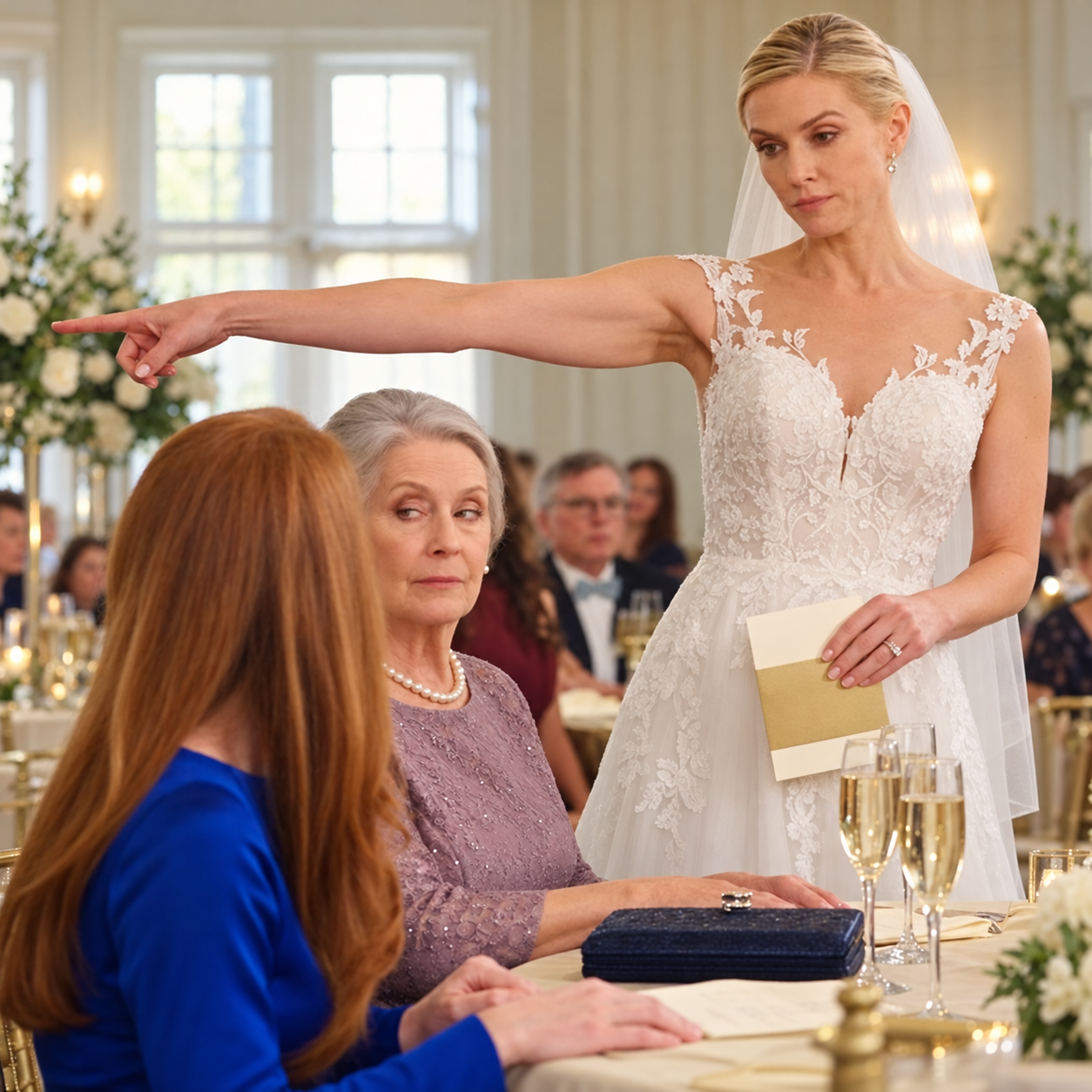
My sister removed my chair from the family table at her wedding while nearly two hundred guests were watching.
She stood in her beautiful white gown, picked up my place card, and pointed toward a tiny table beside the kitchen doors.
“We’ve moved you over there.”
I stared at the empty space between Grandma Margaret and Aunt Patricia.
My chair was gone.
Everyone else’s remained exactly where it belonged.
“Why?” I asked.
Vanessa gave me the tight smile she always used whenever she wanted me to stop asking questions.
“The seating plan changed this afternoon.”
That was a lie.
At nine that morning, she had personally confirmed that I would sit beside Grandma.
I was thirty years old, and Vanessa was my older half-sister.
We shared the same father.
We had shared Christmas mornings, family vacations, school graduations, arguments over borrowed clothes, and the grief of standing beside our father’s grave.
After Dad died, however, Vanessa slowly began emphasizing the word half.
Sometimes she introduced me as “Dad’s younger daughter.”
Not her sister.
I pretended it didn’t hurt.
Standing beside that missing chair, I finally stopped pretending.
“You moved only me.”
Vanessa glanced toward the wedding photographer before replying.
“Clara, please don’t make a scene.”
I almost laughed.
I hadn’t raised my voice.
She had publicly removed me from the family table, yet somehow I was the one threatening to embarrass her.
I looked toward the small table beside the kitchen doors.
Several wedding workers were eating there between shifts.
There was nothing wrong with those people.
The humiliation was the message.
Vanessa wanted the family to see where she believed I belonged.
“Vanessa, I’m your sister.”
Her expression hardened.
She leaned toward me.
“Half-sister.”
One word.
That was all it took.
I remembered our father’s funeral.
Vanessa had held my hand beside the grave and whispered:
“We still have each other.”
I had believed her.
Now I wondered whether she ever had.
For one painful second, I wanted to beg her to reconsider.
Then something inside me became calm.
“All right.”
Vanessa blinked.
“Good.”
I reached for my purse.
Her relief vanished.
“What are you doing?”
“Leaving.”
“You can’t leave.”
That told me everything.
She didn’t want me absent.
An absent sister would make people ask questions.
She wanted me visible.
She wanted me sitting beside the kitchen, smiling politely while everyone understood that she had demoted me.
“No,” I said. “I can.”
I turned toward the ballroom exit.
I had almost reached the dance floor when I heard a chair scrape behind me.
Then another.
Then another.
I stopped.
When I turned, eighty-two-year-old Grandma Margaret was standing beside her chair.
Grandma had arthritis in both knees.
She never stood quickly.
But there she was, handbag tucked beneath one arm, looking directly at Vanessa.
“If Clara isn’t family,” Grandma said, “then neither am I.”
The ballroom went silent.
Vanessa stared at her.
“Grandma?”
Aunt Patricia pushed back her chair.
“I’m leaving too.”
Then Uncle Robert stood.
Then my cousin Hannah.
Within seconds, six members of our family were on their feet.
Vanessa’s face lost color.
“Everyone, please sit down.”
Grandma picked up her place card.
“No.”
“Grandma, this is my wedding.”
“And Clara is your sister.”
“Half-sister.”
Grandma’s expression changed.
“Do not say that to me again.”
Even the quartet had stopped playing.
Vanessa looked around at the guests.
“This is ridiculous. It’s just a seating arrangement.”
Grandma pointed toward my missing chair.
“No, sweetheart. A seating arrangement is putting someone at Table Eight instead of Table Nine.”
Her voice remained calm.
“What you did was remove one person from a family table so everyone would notice she had been removed.”
Vanessa opened her mouth.
Nothing came out.
Then a man approached from behind her.
Adam.
The groom.
He had clearly been pulled away from a conversation after hearing the commotion.
“What happened?”
Vanessa immediately said, “Nothing.”
Grandma answered at the same time.
“Your wife removed Clara from the family table.”
Adam frowned.
He looked at me.
Then at the empty space.
“I thought Clara was sitting here.”
“So did I,” I said.
Adam turned toward Vanessa.
“When did this change?”
She hesitated.
“This afternoon.”
“Why?”
“It was complicated.”
“Vanessa.”
Her jaw tightened.
“My mother’s relatives were uncomfortable.”
That made no sense.
Her mother’s relatives barely knew me.
Aunt Patricia folded her arms.
“Try again.”
Vanessa’s face flushed.
Then she finally said it.
“She isn’t part of my mother’s family.”
I stared at her.
Adam looked stunned.
“She’s still your sister.”
Vanessa whispered fiercely:
“I wanted one photograph with my real family.”
The words traveled farther than she intended.
Grandma’s hand tightened around her purse.
My chest went hollow.
Real family.
There it was.
After years of little corrections and subtle exclusions, Vanessa had finally said aloud what she had been telling me in smaller ways since Dad died.
I nodded.
“Thank you.”
Vanessa stared at me.
“For what?”
“For finally being honest.”
I started walking again.
This time Grandma followed me.
So did Aunt Patricia.
Then Uncle Robert.
Several cousins began gathering their things.
Vanessa panicked.
“Stop!”
Nobody did.
Then Adam said:
“Everybody wait.”
We turned.
He wasn’t looking at us.
He was looking at Vanessa.
“Did you plan this?”
She blinked.
“What?”
“Did you deliberately change Clara’s seat so she wouldn’t be in the family photographs?”
Silence.
Adam’s face fell.
“Oh my God.”
Vanessa reached for him.
“Adam, this is being blown out of proportion.”
He stepped back.
That hurt her more than any accusation.
“I asked you last week if there were family problems I needed to know about.”
“There aren’t.”
“You just told your sister she isn’t your real family in front of two hundred people.”
Vanessa’s eyes filled.
“This is supposed to be my day.”
Grandma answered quietly.
“And that gave you permission to be cruel?”
Vanessa looked toward me.
“You always do this.”
I almost laughed.
“Do what?”
“Make people feel sorry for you.”
“I was leaving.”
“You knew Grandma would react.”
“I didn’t ask anyone to stand.”
Grandma raised one hand.
“She didn’t.”
Then she looked at Vanessa.
“I stood because I remembered what your father asked me before he died.”
That stopped both of us.
“What?” I whispered.
Grandma reached into her handbag.
She removed a small cream envelope.
I recognized my father’s handwriting instantly.
My name and Vanessa’s were written across the front.
Grandma looked suddenly older.
“Your father gave this to me during his last week in the hospital.”
Vanessa stared at the envelope.
“Why have you never shown us?”
“Because he told me not to unless I believed the two of you were forgetting what he had spent his life trying to build.”
My hands began trembling.
Grandma opened it.
Inside was a single handwritten page.
She read:
“My girls will inherit different things from their mothers, but from me they inherit each other. Clara is not half of anything. Vanessa is not more mine because I met her first. If I leave this world before I can make them understand that, then somebody please remind them for me.”
Nobody moved.
Vanessa began crying.
Grandma lowered the paper.
“There’s more.”
She continued.
“A family is not a ranking. The moment one of my daughters believes blood percentage gives her the right to make the other feel smaller, she has misunderstood everything I tried to teach them.”
I couldn’t breathe.
Vanessa covered her mouth.
For the first time all evening, she stopped looking toward the photographer.
She stopped looking at the guests.
She looked at me.
Really looked at me.
“Clara…”
I shook my head.
“Not tonight.”
Her face crumpled.
“I didn’t mean—”
“You did.”
I wasn’t angry when I said it.
That seemed to hurt her more.
“You thought about where to put me. You moved the chair. You changed the place card. You decided I shouldn’t be in the family photos.”
Tears rolled down her cheeks.
“I was angry.”
“At me?”
She looked down.
“No.”
And finally, the deeper truth came out.
After Dad died, his estate had been divided equally between us.
Vanessa had expected more.
Not because our father had ever promised it, but because she had convinced herself that being older—and being the daughter of his first marriage—made her somehow more entitled.
When the will treated us equally, resentment began growing.
Every “half-sister” comment had come from that same wound.
I stared at her.
“So this was never about a chair.”
She shook her head.
“No.”
“No,” I agreed. “It wasn’t.”
Adam quietly asked the guests for a few minutes.
Then he took Vanessa aside.
The wedding reception did not end.
But it changed.
There was no perfect apology followed by immediate forgiveness.
Vanessa returned twenty minutes later without the defensive expression she had worn before.
She stood in front of me.
“I was cruel.”
I said nothing.
She continued.
“I wanted you to feel less important because I was angry that Dad never treated you as less important.”
That was probably the first completely honest thing she had said to me in years.
“I’m sorry.”
I nodded.
“I hear you.”
She waited.
I didn’t say, “It’s okay.”
Because it wasn’t.
Then Grandma did something that made several people laugh through their tears.
She dragged an empty chair back into the space beside hers.
“Well,” she said, “I’m eighty-two, my knees hurt, and I would like dinner.”
A waiter hurried over to help.
I looked at the chair.
Then at Vanessa.
“Do you want me sitting there because you actually want me there?”
She swallowed.
“Yes.”
“Not because everyone is watching?”
“No.”
I sat beside Grandma.
Not because Vanessa had finally permitted it.
Because I had never needed permission.
The family photograph was taken later that evening.
I stood beside Grandma.
Vanessa stood on my other side.
There was space between us.
Not much.
But enough to be honest.
Our relationship did not repair itself that night.
It took months.
There were difficult conversations.
Apologies.
Boundaries.
Moments when I nearly walked away for good.
Vanessa eventually admitted that grief had become resentment, and resentment had become a habit of punishing me for something I had never done.
Years later, when I looked at her wedding photograph, I didn’t remember the flowers or the chandeliers.
I remembered the missing chair.
Because Vanessa thought removing my chair would show everyone where I belonged.
Instead, it revealed something she had spent years hiding.
And when Grandma stood up, the entire family was forced to answer the question Vanessa had tried to answer for them:
Was I really family?
Grandma’s answer had been simple.
“If Clara isn’t family, neither am I.”
It turned out that one empty chair said far more about my sister than it ever said about me.