My Son-in-Law Called Me a Beggar at My Daughter’s Wedding—Then I Took the Microphone
I wore the same old jacket I’d kept for twenty years to my daughter’s wedding. My son-in-law laughed at me in front of everyone. But he had no idea why that jacket meant so much.
The wedding reception was everything my daughter had dreamed of.
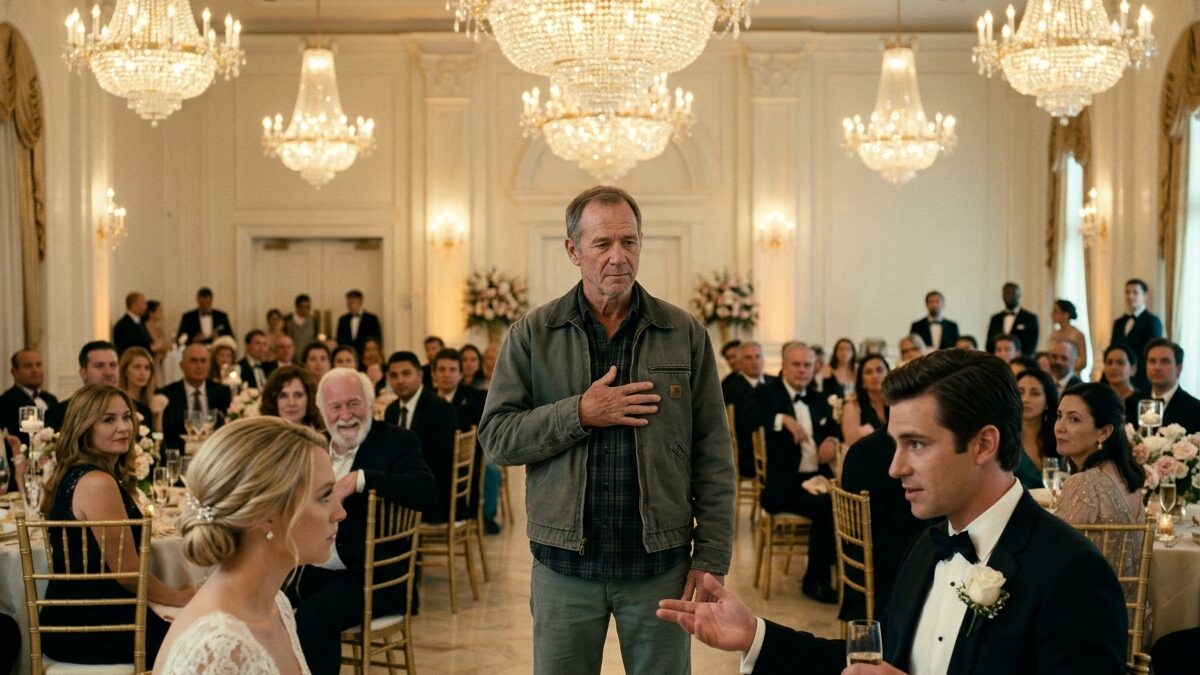
Crystal chandeliers sparkled above elegant round tables. White and pink flowers decorated the ballroom. Guests in expensive suits and beautiful evening gowns raised their champagne glasses as music filled the room.
And there I was.
Standing in the middle of it all, wearing an old, faded jacket.
The fabric was worn. The color had faded over the years. My shoes weren’t particularly impressive either.
I knew I looked different from everyone else.
But I had never imagined that my clothes would become the entertainment of the evening.
“Everyone, Meet My Father-in-Law… the Beggar!”
My new son-in-law stood near one of the tables, holding a glass of champagne.
He looked at me, then glanced around at the guests.
A smirk spread across his face.
“Everyone, meet my father-in-law… the beggar!”
A white-haired gentleman seated beside him burst into laughter.
My son-in-law smiled, clearly pleased with himself.
I could feel people looking in my direction.
Then I saw my daughter.
She stood nearby in her beautiful ivory wedding gown, her blonde hair arranged perfectly for the occasion.
But there was no happiness in her eyes.
Only embarrassment and pain.
“Dad…” she whispered.
I knew what she was thinking.
She wanted to defend me. She wanted the laughter to stop.
But I didn’t want her wedding day to become an argument.
I placed my hand over the front of my jacket and gave her a gentle look.
“It’s all right, sweetheart.”
And I meant it.
Because I knew something about that jacket that nobody else in the room understood.
The Jacket I Had Kept for Twenty Years
I looked down at the faded fabric.
To everyone else, it was just an old piece of clothing.
To me, it represented twenty years of my life.
Twenty years of early mornings, long working days and late nights.
Twenty years of making sure my daughter had what she needed, even when I went without things myself.
My daughter had grown up seeing me wear that jacket.
She had seen me come home exhausted from work. She had watched me hang it beside the door, then sit down to ask her about school.
As she grew older, the jacket became worn.
But I couldn’t bring myself to replace it.
Not because I didn’t understand how to dress for a wedding.
And not because I wanted anyone to feel sorry for me.
I kept it because it reminded me of the years that had brought my daughter to this moment.
The moment she would begin a new chapter of her own life.
I Walked Toward the Microphone
The laughter was beginning to fade.
I lowered my hand and started walking.
My old brown shoes made soft sounds against the polished marble floor.
The tables, the flowers and the glittering chandeliers seemed unusually bright as I approached the microphone.
I stopped in front of it.
Then I adjusted it to my height.
The guests slowly became quiet.
My daughter watched from across the room.
My son-in-law still had his champagne glass in his hand.
I looked toward him and spoke.
“You laughed at my old jacket. But you don’t know its story.”
The room fell silent.
What I Told the Wedding Guests
“I’ve had this jacket for twenty years,” I began.
“It isn’t fashionable. And I know it doesn’t belong in a room full of expensive suits.”
I paused.
“But this jacket was with me through the years when my daughter needed me most.”
I looked toward her.
“I wore it when I left for work before sunrise. I wore it when I came home late. I wore it on days when I was tired, when money was tight, and when I wondered whether I was doing enough.”
My voice softened.
“Every time I came home, my daughter reminded me why I kept going.”
I looked down at the old sleeves.
“I could have bought another jacket. But I never wanted to forget the person I was while raising her.”
Nobody laughed now.
“Today, my daughter is standing here in a beautiful wedding dress, beginning a new life. And I wanted to bring a small piece of our journey with me.”
I took a breath.
“This jacket may look like it has very little value.”
Then I looked directly at my son-in-law.
“But it reminds me of the most valuable thing I’ve ever been part of—watching my daughter grow into the woman she is today.”
The Smile Disappeared From His Face
My son-in-law was still holding his champagne glass.
But he was no longer smiling.
His eyes widened.
The confidence he had shown moments earlier had disappeared.
The white-haired gentleman who had laughed so loudly was now staring at me with a serious expression.
Nearby, an older woman in a sparkling navy-blue dress stood quietly, watching.
I hadn’t raised my voice.
I hadn’t insulted anyone.
I had simply explained why I was proud to wear something they had found so amusing.
And somehow, the room felt very different.
The Words I Wanted My Daughter to Remember
I turned toward my daughter.
“Sweetheart, I didn’t come here to impress anyone with my clothes.”
I smiled gently.
“I came because I’m proud of you.”
Her eyes filled with tears.
“And I hope the life you build is filled with people who value you for who you are, not for what you wear or how much money you have.”
I looked toward the guests one final time.
“A good jacket can keep you warm. But kindness and respect are what make a person worth remembering.”
Then I stepped away from the microphone.
There was nothing more I needed to prove.
A Lesson Bigger Than an Old Jacket
That day reminded me how quickly people can judge someone by their appearance.
An old coat can be mistaken for failure.
Worn shoes can be mistaken for a lack of dignity.
And a quiet person can be mistaken for someone who has nothing meaningful to say.
But clothing cannot reveal the years of effort, love or sacrifice behind a person’s life.
I had walked into that wedding wearing the same jacket I’d kept for twenty years.
I walked away still wearing it.
The jacket hadn’t changed.
But the way people looked at it had.
Never measure a person’s worth by the clothes they wear. Sometimes, the oldest things we carry hold the stories that matter most.