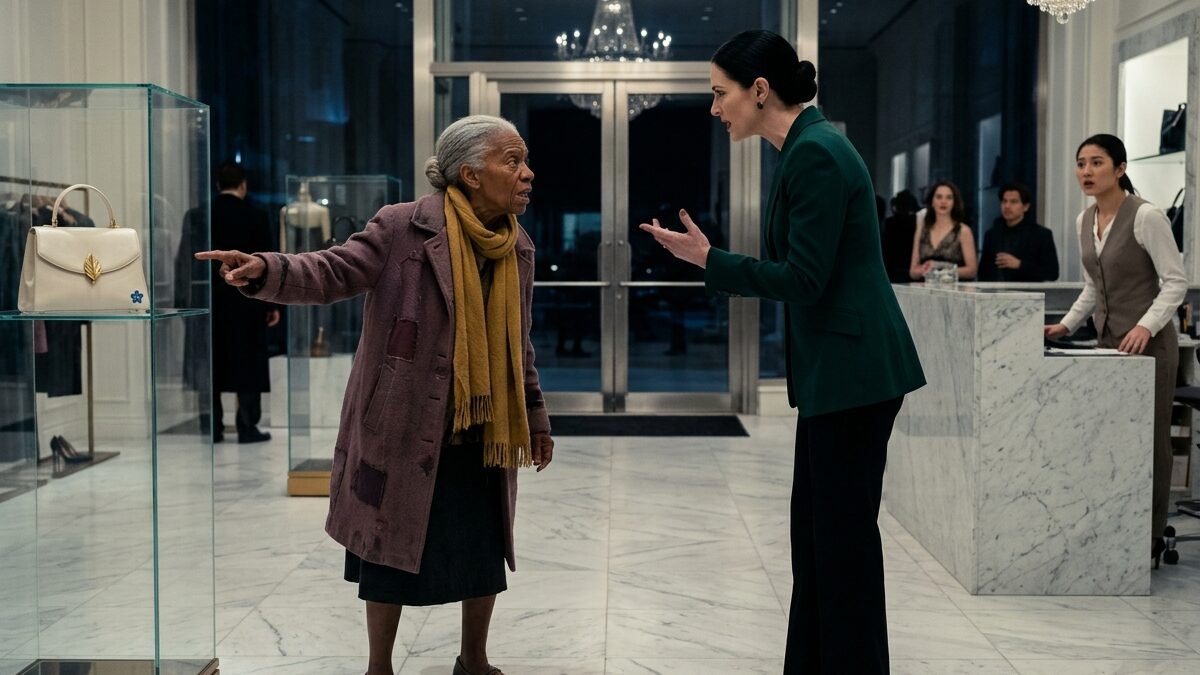
She Threw a Poor Old Woman’s Bag on the Floor… Then the Luxury Store Owner Revealed the Truth!
At 9:15 p.m., a 77-year-old woman walked into one of Manhattan’s most luxurious handbag boutiques. Her coat was faded, her shoes were worn, and her hands were rough from a lifetime of sewing. She carried an old brown leather handbag that looked almost worthless.
The store manager took one look at her, snatched the bag from her hands, and threw it onto the marble floor.
But when the boutique’s owner arrived, she recognized the elderly woman immediately.
What she revealed left everyone in the store speechless.
A Poor Old Woman in a Store Full of Luxury
It was a beautiful evening in Manhattan.
Outside, the sky was dark, and the city’s expensive shopping avenue shimmered with golden lights.
Inside an exclusive designer handbag boutique, a magnificent crystal chandelier illuminated polished white marble floors.
Cream-colored walls were decorated with elegant gold trim.
Beautiful leather handbags rested on illuminated glass shelves.
Some were black.
Others were caramel, ivory, or taupe.
Each looked like a work of art.
Wealthy customers browsed the collection while impeccably dressed employees offered assistance.
Then the glass entrance doors opened.
An elderly woman stepped inside.
Her name was Mabel Turner.
She was 77 years old.
And she looked nothing like the boutique’s usual customers.
Mabel was small and thin, with narrow shoulders and a slightly stooped back.
Deep wrinkles lined her forehead.
Her cheeks were hollow, and her tired brown eyes carried the marks of a difficult life.
Her silver-gray hair was gathered into a small bun.
She wore a faded dusty-plum coat with patches on the elbows, an old beige cardigan, a charcoal skirt, and badly scuffed brown shoes.
A worn mustard-yellow scarf hung loosely around her neck.
Her hands were especially weathered.
The skin was thin.
The knuckles were slightly bent.
Her fingertips were rough from decades of needlework.
But Mabel was clean, dignified, and quietly smiling.
In both hands, she held a small chestnut-brown leather handbag.
The corners were scuffed.
The stitching was uneven in places.
The brass clasp was scratched.
It was clearly old.
Yet Mabel held it with extraordinary care.
Because this was not just any handbag.
The Handbag Behind the Glass
Mabel moved slowly toward a beautiful glass display on the left side of the boutique.
Inside sat a pearl-ivory designer handbag.
Its leather was flawless.
Its shape was elegant.
A polished gold clasp shaped like a leaf decorated the front.
And on the lower right corner of the flap was a tiny embroidered blue flower.
Five petals.
Sapphire blue.
Mabel stopped.
Her eyes widened.
Then, for the first time that evening, she smiled.
“Oh, my goodness,” she whispered.
She raised her old brown handbag slightly.
It had the same leaf-shaped clasp.
The same little blue flower.
The same carefully designed proportions.
She looked between the two bags.
One was old and worn.
The other rested proudly beneath expensive lighting.
But their resemblance was unmistakable.
Mabel’s eyes became moist.
“I never thought I’d see it again,” she murmured.
She had no idea someone was watching her.
“This Store Isn’t for Beggars!”
Victoria Hale, 43, was the boutique manager.
She wore an expensive dark-emerald blazer, an ivory silk blouse, tailored black trousers, and pointed high heels.
Her black hair was pulled tightly into a sleek bun.
Victoria took enormous pride in the store’s elegant appearance.
But she had developed an unpleasant habit.
She judged customers by how wealthy they looked.
And the moment she noticed Mabel, she made up her mind.
An old coat.
Worn shoes.
A cheap-looking handbag.
To Victoria, those details meant only one thing.
This woman didn’t belong there.
Victoria approached briskly.
“Excuse me. Can I help you?”
Mabel turned and smiled.
“Oh, hello, dear. I was just looking at that beautiful handbag.”
She gestured toward the glass display.
Victoria looked at her suspiciously.
“Are you planning to buy something?”
Mabel hesitated.
“Well, not today. I simply wanted to see—”
Victoria cut her off.
“This is a private luxury shopping event.”
Mabel nodded politely.
“I understand. I won’t be any trouble.”
Victoria’s gaze moved to the old brown bag.
“Where did you get that?”
Mabel looked down.
“Oh, I made this myself. A very long time ago.”
Victoria gave a dismissive laugh.
“You made that?”
“Yes, dear.”
Mabel lifted the old bag slightly.
“I used to sew leather handbags.”
Victoria’s expression hardened.
She assumed the elderly woman was inventing a story to avoid being asked to leave.
Then she did something cruel.
She reached forward and snatched the old handbag directly from Mabel’s hands.
“Please!” Mabel gasped.
Victoria swung her arm downward.
She threw the handbag onto the polished white marble floor.
The worn leather struck the stone with a sharp sound.
Mabel stared.
Her small, wrinkled hands remained open in front of her.
Victoria pointed toward the entrance.
Then she shouted:
“THIS STORE ISN’T FOR BEGGARS!”
Two nearby customers turned around.
One looked shocked.
The other glanced away awkwardly.
Mabel’s cheeks grew warm with embarrassment.
For several seconds, she said nothing.
Then she raised one trembling hand toward the beautiful ivory handbag in the glass case.
Her voice was quiet but clear.
“BUT… I MADE THAT DESIGN!”
Victoria rolled her eyes.
“Of course you did.”
The Young Employee Who Noticed Something
Behind the marble sales counter stood Lily Chen.
She was 28 years old, a junior sales associate who had joined the boutique because she loved leather craftsmanship.
Unlike Victoria, Lily cared about how things were made.
She had studied the history of the brand.
She knew about its earliest handbag collection.
She knew the shape of the original clasp.
And she knew the story of the tiny blue flower.
When Victoria threw the elderly woman’s bag onto the floor, Lily felt a wave of embarrassment.
She had never seen a customer treated so badly.
Victoria turned toward her.
“LILY! THROW HER OUT!”
But Lily didn’t move toward the doors.
Instead, she walked toward the old brown handbag.
She crouched and carefully picked it up.
“I’m sorry about this, ma’am,” she told Mabel.
Then her eyes fell on the clasp.
A brass leaf.
Scratched, but beautifully shaped.
Next, she noticed the blue flower embroidered onto the leather.
Five delicate petals.
Her expression changed.
Lily turned toward the pearl-ivory handbag inside the glass display.
She compared the details.
Then she looked back at the worn brown bag in her hands.
Her heart began racing.
“No…” she whispered.
She had seen photographs of a similar handbag in the company’s design archives.
An original handmade prototype.
A piece considered enormously important to the brand’s history.
Lily looked at Mabel.
Then at Victoria.
And she exclaimed:
“WAIT! THAT’S THE ORIGINAL!”
Victoria frowned.
“What are you talking about?”
Lily raised the old bag.
“The clasp. The embroidery. The stitching. This is the design our first collection was based on!”
Victoria scoffed.
“That’s impossible.”
But before Lily could explain further, the boutique’s glass entrance doors opened.
The Woman in the Burgundy Suit
A woman stepped inside.
She was 42 years old, elegantly dressed in a deep-burgundy tailored pantsuit.
Her dark espresso-brown hair fell in soft waves to her shoulders.
A small gold leaf-shaped brooch decorated her jacket.
Her name was Clara Reyes.
She was the founder, owner, and creative director of the luxury handbag company.
Clara had built the brand from a tiny design business into a successful international fashion enterprise.
Her handbags were admired for their beautiful leatherwork, distinctive clasps, and delicate embroidered details.
Victoria immediately straightened her posture.
“Ms. Reyes! Good evening.”
But Clara barely heard her.
She had noticed the elderly woman standing in the middle of the boutique.
The faded coat.
The silver-gray hair.
The deeply lined face.
Clara stopped walking.
For a moment, she looked as though she had seen a ghost.
Then she took a step closer.
Her voice trembled.
“MABEL?!”
The elderly woman slowly looked up.
She studied Clara’s face.
The years had changed her former student.
But those warm, expressive eyes were familiar.
“Clara?” Mabel whispered.
Clara hurried forward.
Lily still held the old brown handbag.
Clara reached for it carefully.
When she saw the scratched leaf-shaped clasp and the little blue flower, her eyes filled with tears.
She held the bag against her chest.
Then she turned toward Victoria.
“SHE TAUGHT ME TO MAKE THIS!”
Victoria’s mouth fell open.
“WHAT?!”
Clara raised her free hand toward the shelves filled with expensive designer handbags.
Then she announced:
“EVERY BAG HERE STARTED WITH HER!”
The boutique fell silent.
Victoria stared at Mabel.
The poor elderly woman she had just insulted…
The woman whose handbag she had thrown onto the floor…
Was the person who had inspired the design that made the entire brand possible.
Twenty-Four Years Earlier
Long before the marble floors, crystal chandeliers, and expensive storefronts, Clara was an eighteen-year-old girl with a dream.
She wanted to become a fashion designer.
But her family had little money.
She couldn’t afford an expensive design school.
She couldn’t buy high-quality leather.
And the fashionable studios she approached rarely took her seriously.
One afternoon, while walking through an older neighborhood, Clara noticed a tiny sewing workshop.
The shop had a faded sign.
Its windows were crowded with fabric scraps, thread, and old tools.
Inside sat a woman working with a needle.
That woman was Mabel Turner.
Mabel was 53 years old at the time.
She had spent much of her adult life repairing shoes, sewing bags, and making clothing alterations.
Her income was modest.
Some months were especially difficult.
But her skill with leather was extraordinary.
Clara stood at the doorway and watched her work.
Finally, she asked:
“Excuse me. Could you teach me how to do that?”
Mabel looked up.
“How to sew leather?”
Clara nodded.
“I want to make handbags. But I don’t have money for classes.”
Mabel studied the young woman’s face.
She recognized something familiar.
Determination.
Hope.
And the fear that a dream might be impossible.
She pulled out a chair.
“Sit down, sweetheart.”
Clara hesitated.
“How much will it cost?”
Mabel smiled.
“Let’s see what you can learn first.”
That afternoon, Clara stayed for hours.
And she returned the following day.
Then the next.
The First Handbag
For months, Mabel taught Clara everything she knew.
How to cut leather without wasting material.
How to reinforce a handle.
How to sew a seam that would last.
How to choose the right clasp.
And how to turn a simple idea into something useful and beautiful.
Mabel was patient.
When Clara made mistakes, she didn’t scold her.
She showed her how to fix them.
One afternoon, Mabel brought out a small piece of chestnut-brown leather.
She wanted to teach Clara how to construct a structured handbag.
They worked together for several days.
Mabel shaped the body and stitched the seams.
Then she attached a small brass clasp shaped like a leaf.
Clara admired it.
“Why a leaf?”
Mabel smiled.
“Because leaves remind me that life keeps growing, even after difficult seasons.”
Then she picked up a needle threaded with sapphire-blue cotton.
She embroidered a tiny five-petal flower onto the front of the bag.
Clara watched closely.
“Why blue?”
“My mother used to stitch little blue flowers onto the things she made,” Mabel explained.
“She said a small beautiful detail can make an ordinary thing feel special.”
Clara smiled.
“It’s perfect.”
Mabel shook her head.
“Nothing handmade is perfect. That’s what makes it special.”
That chestnut-brown handbag became the first design Clara ever truly loved.
And years later, its distinctive elements would become recognizable throughout the luxury fashion world.
How Clara’s Dream Became a Fortune
After learning from Mabel, Clara began making handbags of her own.
At first, she sold them at small weekend markets.
Some days, she sold nothing.
Other days, she earned just enough to buy more supplies.
But she kept improving.
She experimented with new leather colors.
She refined the shapes.
She improved the hardware.
Yet she always returned to the details that had made Mabel’s first bag so memorable.
The leaf-shaped clasp.
The five-petal blue flower.
The careful construction.
Eventually, a small boutique agreed to carry Clara’s designs.
Then another.
Then a department store placed an order.
Clara opened her first workshop.
She hired employees.
Her business grew.
Within years, her handbags were selling in luxury stores.
And as success arrived, her life became increasingly complicated.
The workshop where she had learned to sew closed.
Mabel moved away.
Clara lost her old phone number and address.
They stopped seeing each other.
At first, Clara assumed they would meet again.
But months became years.
Years became decades.
And although Clara often spoke about the elderly woman who had taught her, she never managed to reconnect.
She had preserved the design.
But she had failed to preserve the relationship.
Why Mabel Was Still Poor
While Clara’s career flourished, Mabel’s life took a different path.
Her small sewing workshop struggled as rents increased and cheaper mass-produced goods became more common.
Later, health problems made it difficult for her to work as many hours.
Her fingers, once quick and steady, grew stiff with age.
She continued doing small repairs when she could.
But the income was never enough to build savings.
She lived in a modest apartment.
She bought groceries carefully.
And when her coat wore thin, she patched the elbows rather than replacing it.
The old chestnut-brown handbag remained one of her most treasured possessions.
Not because she expected it to become valuable.
But because it reminded her of her mother, her years of craftsmanship, and the young woman she had once helped.
Mabel knew that Clara had become successful.
She had occasionally heard her name.
But she didn’t understand how large the brand had grown.
Until one evening, she saw a photograph of a beautiful pearl-ivory handbag.
There was the leaf clasp.
And the little blue flower.
Mabel stared at the photograph for a long time.
She felt proud.
Not jealous.
Not angry.
Proud that something they had created together had traveled so far.
When she learned that a boutique was hosting a private evening shopping event, she decided to visit.
She brought her old handbag.
She wanted to see the new design with her own eyes.
And perhaps, if she was fortunate, she might see Clara again.
She never expected to be humiliated at the door of her former student’s success.
“Why Didn’t You Tell Me You Were Struggling?”
Back in the boutique, Clara stood beside Mabel.
She noticed the patches on her old coat.
The worn shoes.
The scarf that had clearly seen many winters.
Her expression changed.
“Mabel… why didn’t you tell me you were having such a hard time?”
Mabel smiled sadly.
“Oh, sweetheart. You had your own life to build.”
Clara shook her head.
“But you helped me build it.”
Mabel lowered her eyes.
“I only taught you what I knew.”
Clara looked at the old handbag in her hands.
“You taught me far more than that.”
She remembered the long afternoons in the tiny workshop.
The cups of tea.
The corrections.
The encouragement.
The days when she had wanted to give up.
And the older woman who kept telling her to try again.
Clara’s eyes filled with tears.
“I should have tried harder to find you.”
Mabel gently touched her arm.
“We’re here now, dear.”
For a moment, Clara couldn’t speak.
Then she turned toward Victoria.
“You Were Wrong Before You Knew Who She Was”
Victoria stood rigidly near the marble counter.
Her expensive emerald blazer suddenly seemed less impressive.
“Ms. Reyes,” she began, “I didn’t realize she had any connection to the company.”
Clara looked at her.
“Does that matter?”
Victoria hesitated.
“I mean… I didn’t know she was important.”
Clara’s expression grew serious.
“Mabel would still deserve respect if she had never touched a needle in her life.”
Victoria looked away.
Clara continued.
“You didn’t ask whether she needed assistance.”
“You didn’t ask why she came.”
“You took her personal property and threw it onto the floor.”
Victoria swallowed.
“I thought she was trying to cause trouble.”
“Because of her clothes?”
No answer.
Clara held up the old handbag.
“This is one of the most important designs in our company’s history.”
She paused.
“But even if it were an ordinary old bag, you would have had no right to treat its owner that way.”
Lily stood nearby, quietly listening.
Mabel’s eyes filled with tears again.
For years, people had looked past her because she was old and poor.
Now someone was finally speaking up.
Not because Mabel was secretly wealthy.
But because she was a person who deserved dignity.
The Manager’s Consequences
Clara asked Lily to help Mabel find a comfortable place to sit.
Then she requested that the store’s security footage be preserved.
She wanted the incident documented properly.
Victoria was removed from customer-facing duties for the remainder of the evening.
A formal review followed, including the video footage and statements from those who had witnessed the confrontation.
The findings confirmed that Victoria had deliberately mistreated Mabel and thrown her property.
Her employment was subsequently terminated.
The decision wasn’t based on Mabel’s connection to Clara.
It was based on her behavior toward a customer.
Clara also arranged additional staff training on respectful service, discrimination, and handling customer complaints.
She wanted the incident to change more than one person’s position in the company.
She wanted to make sure it did not happen again.
Victoria eventually sent Mabel an apology.
Mabel read it carefully.
She appreciated the acknowledgment.
But she did not pretend the humiliation had never happened.
Forgiveness, she knew, could not be demanded.
The Offer Mabel Never Expected
Several days later, Clara invited Mabel to a private meeting at the company’s design studio.
This time, there was no crowd.
No confrontation.
No manager shouting at her.
Just a comfortable chair, a pot of tea, and a table covered with sketches.
Clara placed the old chestnut-brown handbag gently on the table.
Then she showed Mabel drawings from her earliest collections.
“Look,” she said.
Mabel leaned closer.
The handbags were different colors and shapes.
But the original influence was unmistakable.
Clara took a breath.
“I want our customers to know where these designs came from.”
Mabel looked surprised.
“Oh, Clara, you don’t have to make a fuss over me.”
“I do need to give you proper credit,” Clara replied.
She explained that she wanted to formally acknowledge Mabel’s contribution to the brand’s design history.
She also proposed a financial arrangement that would compensate Mabel for the continued use of the signature design elements and recognize her contribution going forward.
Clara offered to pay for independent legal advice so Mabel could review the agreement without pressure.
Mabel listened quietly.
She had never imagined that teaching someone years earlier could lead to a conversation like this.
“Are you sure?” she asked.
Clara smiled.
“I should have had this conversation with you a long time ago.”
A New Collection With an Old Story
In the months that followed, the company introduced a special heritage collection inspired by the original brown handbag.
The collection was called The Mabel Collection.
Its centerpiece was a beautifully crafted modern handbag.
It had soft chestnut-brown leather.
A delicate gold leaf-shaped clasp.
And a tiny blue five-petal flower embroidered by hand.
Alongside it, the brand shared the story of the woman who had created the original design and taught Clara the art of handbag making.
Mabel was invited to participate as an honorary craft mentor and paid design adviser, on a schedule that suited her health and energy.
She did not have to return to long days of physical work.
Instead, she could share her knowledge with younger craftspeople who wanted to learn.
The company also established a training fund for aspiring designers who could not afford traditional fashion education.
It was Mabel’s favorite part of the plan.
“That’s how you keep something beautiful alive,” she told Clara.
“By teaching someone else.”
The Day Mabel Returned to the Boutique
Months later, Mabel stepped through the same glass doors where she had once been humiliated.
The chandelier still sparkled.
The marble floor still gleamed.
The expensive handbags still rested on illuminated shelves.
But something had changed.
A small heritage display now featured her original chestnut-brown handbag.
The worn leather had been carefully conserved without erasing its age.
Its hand-stitched seams remained visible.
Its brass clasp still carried the marks of time.
And the little sapphire-blue flower still rested on the front flap.
Mabel stood in front of it.
Her eyes filled with tears.
Lily approached with a warm smile.
“Good evening, Ms. Turner.”
Mabel laughed softly.
“Oh, Lily. Just Mabel is fine.”
Clara joined them.
She looked at the elderly woman’s old coat.
It was still faded.
Mabel had been offered a beautiful new one, but she had chosen to keep wearing this one on ordinary days.
“It’s comfortable,” she explained.
Clara smiled.
“Then you should wear it.”
Mabel looked around the boutique.
And for the first time, she saw her old creation celebrated openly.
Not hidden.
Not dismissed.
Not thrown onto the floor.
Honored.
The Most Important Thing Mabel Asked For
After the event, Clara asked Mabel whether there was anything else she wanted.
Mabel thought for a moment.
Then she said:
“Yes. There is.”
Clara leaned closer.
“Tell me.”
Mabel glanced toward the young employees arranging handbags on the shelves.
“When someone comes into this store looking poor, please don’t make them feel small.”
Clara nodded.
Mabel continued.
“You never know what someone has been through.”
“Or what they have given.”
“Or what they know.”
She smiled gently.
“And even if they have nothing special to offer, they still deserve kindness.”
Clara took her hand.
“I promise.”
Mabel looked toward the little blue flower on the heritage display.
It reminded her of her mother.
Of her tiny sewing workshop.
Of the eighteen-year-old student who had once asked for help.
And of all the years that had passed.
For much of her life, Mabel had believed that her work would be forgotten.
Now she understood that a simple act of teaching had changed another person’s life in ways she could never have predicted.
The Lesson Behind the Old Brown Handbag
Victoria had looked at Mabel and seen only a poor elderly woman.
She saw the faded coat.
The patched elbows.
The worn shoes.
And the old leather handbag.
She assumed that Mabel had nothing valuable to offer.
But she was wrong.
Mabel had knowledge that could not be bought in a luxury boutique.
She had patience.
She had talent.
And she had spent years helping others learn a craft she loved.
The expensive handbags on the shelves were beautiful.
But their beauty had roots in a tiny workshop where a struggling young woman once learned to sew.
The most valuable thing Mabel gave Clara wasn’t a handbag.
It was the belief that she could create something extraordinary.
And the greatest mistake Victoria made wasn’t failing to recognize a famous designer.
Mabel wasn’t famous when she entered the store.
She wasn’t wealthy.
She wasn’t pretending to be poor to test anyone’s character.
She was exactly what she appeared to be: an elderly woman who had experienced hardship.
She deserved respect before anyone knew her story.
She deserved respect when she walked through the doors.
When she smiled at the display.
When she held her worn handbag.
And even when nobody knew her name.
Because a person’s dignity is not determined by their clothing, their bank account, or the price of the things they own.
Sometimes, the person wearing the oldest coat has spent a lifetime creating something beautiful.
And sometimes, the most valuable treasure in a luxury store is an old brown handbag held together by careful stitches, loving memories, and the hands of someone the world nearly forgot.
❤️ What would you have done if you saw a store manager throw a poor elderly woman’s handbag onto the floor?
Do you think Victoria deserved to lose her job?
And do you believe Clara did enough to make things right for Mabel?
Share your thoughts in the comments.
This is a fictional story about kindness, dignity, craftsmanship, gratitude, prejudice, and respecting people regardless of their financial circumstances.