Emily Carter had worked at the Grand Royal Hotel in New York for three years, but she had never witnessed anything as strange as what happened that evening.
The hotel was hosting an exclusive charity gala attended by some of the wealthiest people in the city.
Crystal chandeliers illuminated the ballroom. Elegant guests enjoyed expensive champagne while waiters moved silently between tables.
Emily, twenty-four, was working her usual evening shift.
She had never cared much about wealthy people or their luxurious lifestyles. She was simply trying to earn enough money to finish nursing school and support her adoptive mother, who had recently become ill.
As she passed a table near the ballroom’s entrance, an elderly woman suddenly grabbed her attention.
— Wait! Young lady!
Emily stopped immediately.
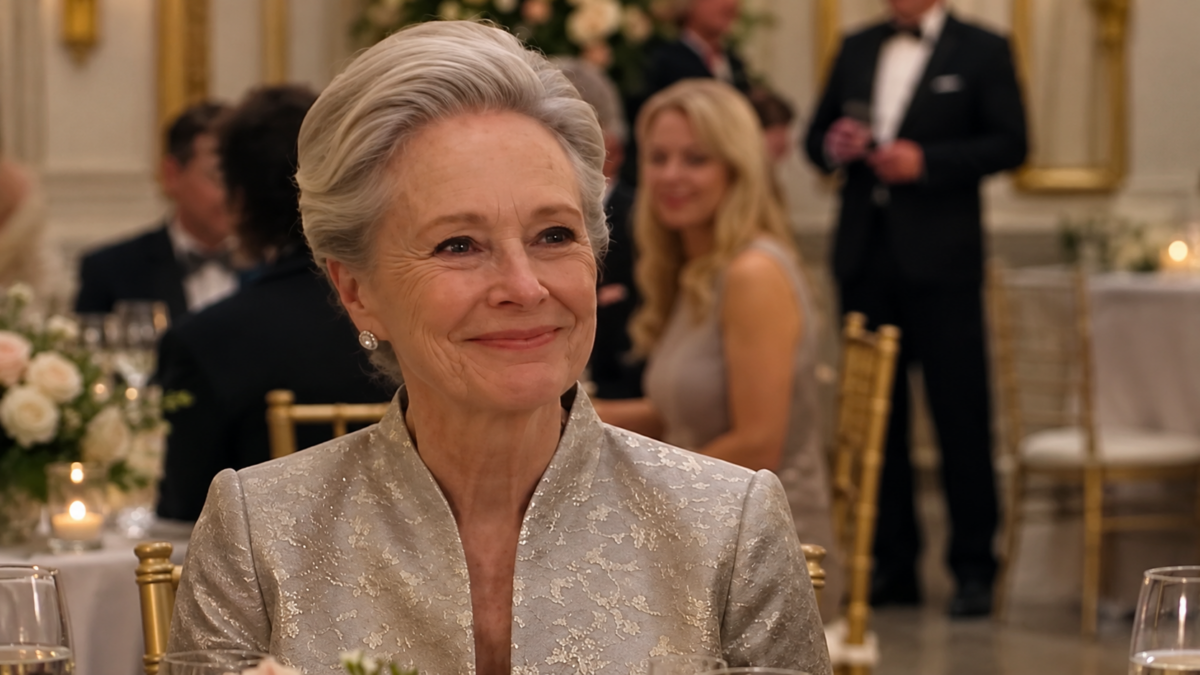
The woman was Margaret Whitmore, a seventy-year-old billionaire known for owning several hotels and charitable foundations.
Her silver hair was neatly arranged, and her champagne-colored jacket sparkled beneath the chandeliers.
— Yes, ma’am? Can I help you?
Margaret didn’t answer.
Instead, she stared at Emily’s wrist.
A small crescent-shaped birthmark was visible just below her sleeve.
Margaret’s face suddenly turned pale.
— That mark… on your wrist…
Emily instinctively covered it.
— Oh, this? It’s just a birthmark.
Margaret slowly stood up.
— Did you have that mark when you were a little girl?
Emily looked confused.
— Yes, ma’am. I’ve had it since I was born.
Margaret gripped the edge of the table.
Her hands were trembling.
— Tell me something, sweetheart.
Emily waited.
Margaret’s voice became barely audible.
— Was your mother’s name… Elizabeth?
Emily froze.
Her heart seemed to stop.
— How… how do you know my mother’s name?
Margaret covered her mouth.
Tears appeared in her eyes.
— Oh, my God…
Emily stepped backward.
— Ma’am, who are you?
Instead of answering, Margaret reached into the inside pocket of her jacket.
She pulled out an old photograph with faded white edges.
Her trembling fingers held it toward Emily.
— Please… look at this.
Emily glanced down.
The photograph showed a little girl wearing a white dress and a matching bow in her hair.
The child was sitting beside a young woman who was smiling lovingly at the camera.
Emily recognized the dress immediately.
She had seen it before.
In her childhood dreams.
Her eyes widened.
She raised one hand to cover her mouth.
— OH MY GOD… THAT PHOTO IS…!
Margaret began crying.
— It’s you, Emily.
The young waitress stumbled backward.
— That’s impossible!
Margaret slowly turned the photograph over.
On the back, written in faded blue ink, were the words:
“Elizabeth and my little Emily. Summer, 2004.”
Emily felt her knees weaken.
Her adoptive mother had once shown her a damaged photograph containing the same little girl.
But in that photograph, the woman beside her had been cut away.
For twenty years, Emily had wondered who that woman was.
And now a complete version of the picture was in a stranger’s hands.
— Where did you get this? Emily whispered.
Margaret took a deep breath.
— Because the woman in that photograph was my daughter.
Emily stared at her.
— Your daughter?
Margaret nodded.
— Elizabeth Whitmore.
A heavy silence settled between them.
Then Margaret spoke the words Emily had never expected to hear.
— And you, Emily… are my granddaughter.
Emily shook her head violently.
— No. That can’t be true.
Margaret looked devastated.
— I know it sounds impossible. But I’ve spent twenty years searching for you.
Emily’s voice trembled.
— Searching for me? Then where were you when I needed you?
The question struck Margaret like a knife.
She slowly sat down.
— You deserve to know everything.
Twenty years earlier, Elizabeth Whitmore had been the only daughter of one of New York’s wealthiest families.
Margaret had raised her with strict expectations.
She wanted Elizabeth to marry a powerful businessman, continue the family legacy, and live a life of luxury.
But Elizabeth fell in love with a young musician named Thomas Carter.
Thomas wasn’t wealthy.
He played piano in small restaurants and taught music to children.
Margaret disapproved immediately.
— He’s only interested in our money! she had warned.
Elizabeth refused to abandon him.
Eventually, she left the family mansion.
She married Thomas in a small ceremony, and a year later, Emily was born.
For a while, they were happy.
But when Emily was four, tragedy struck.
Thomas died in a car accident.
Elizabeth was devastated.
She struggled financially while trying to raise her daughter alone.
Desperate, she wrote several letters to Margaret.
She begged her mother for help.
But the letters never reached her.
Margaret’s business manager, Richard Collins, intercepted them.
Richard had managed the Whitmore family’s finances for decades.
He feared Elizabeth’s return because he had secretly been stealing money from the family businesses.
If Elizabeth came home, she might discover his crimes.
So Richard created a terrible lie.
He told Margaret that Elizabeth had moved overseas and wanted no further contact.
Then he told Elizabeth that Margaret had rejected every request for help.
Mother and daughter remained separated.
Until one terrible winter night.
Elizabeth became seriously ill.
She was hospitalized after collapsing at work.
Four-year-old Emily was temporarily placed in emergency care.
Before Elizabeth could recover, she died from complications of her illness.
Richard learned about her death before Margaret did.
He manipulated documents and concealed information about the child.
By the time authorities discovered inconsistencies, Emily had already entered the foster-care system under incomplete records.
Eventually, she was adopted by a kind woman named Sarah.
Margaret believed Elizabeth had disappeared voluntarily.
She didn’t learn about her daughter’s death until years later.
When she finally discovered the truth, she began searching for her granddaughter.
But the records were incomplete, names had changed, and the trail seemed to end.
Margaret never stopped looking.
— Every Christmas, I imagined you opening presents somewhere, she told Emily.
Tears rolled down her cheeks.
— Every birthday, I wondered whether you were happy.
Emily stood motionless.
— Why didn’t you find me sooner?
Margaret lowered her head.
— Because I trusted the wrong man. And because my pride had driven your mother away before any of this happened.
Emily wiped her tears.
— My adoptive mother told me Elizabeth loved me. But she never knew much about my family.
Margaret gently touched the old photograph.
— Your mother loved you more than anything.
Emily looked at the picture again.
The little girl in the white dress was smiling.
For the first time in her life, Emily saw her mother’s entire face.
She began sobbing.
Margaret moved closer.
— May I hug you?
Emily hesitated.
Then she nodded.
The elderly woman wrapped her arms around her granddaughter.
Both began crying.
Several guests watched in astonishment, unaware of the extraordinary reunion taking place before them.
But the story was far from over.
The following morning, Margaret invited Emily to her private office.
There, she showed her documents, letters, photographs, and records from the investigation into Elizabeth’s disappearance.
She also offered to arrange a DNA test.
— I don’t expect you to believe everything immediately, Margaret explained. You deserve proof.
Emily agreed.
Two weeks later, the results confirmed their biological relationship.
Margaret was indeed her grandmother.
Yet Emily had one question she couldn’t forget.
— What happened to Richard Collins?
Margaret’s expression darkened.
— He’s still alive.
Emily stared at her.
— And he still works for you?
Margaret shook her head.
— He retired five years ago. I only recently uncovered evidence suggesting he had interfered with Elizabeth’s letters.
Emily clenched her fists.
— Then he needs to answer for what he did.
Margaret agreed.
Together, they contacted an attorney and submitted the evidence to investigators.
The investigation uncovered decades-old financial misconduct, intercepted correspondence, and deliberately falsified records.
Richard initially denied everything.
But preserved banking documents and testimony from former employees contradicted his claims.
Eventually, he admitted that he had concealed Elizabeth’s attempts to reconcile with her mother.
He had never expected the consequences to be so devastating.
Legal proceedings followed, and Richard was held accountable for the offenses prosecutors could establish.
For Emily, however, punishment couldn’t restore the years she had lost.
Nor could it bring Elizabeth back.
One evening, she visited her adoptive mother, Sarah.
Sarah was sitting beside the window, knitting a blue scarf.
— Mom, there’s something I need to tell you.
Emily sat beside her.
She explained everything.
The birthmark.
The photograph.
Margaret.
The DNA test.
When Emily finished, Sarah quietly wiped her eyes.
— So you found your grandmother.
Emily nodded.
Then she began crying.
— Mom… please don’t think this changes anything between us.
Sarah immediately embraced her.
— Oh, sweetheart.
She kissed Emily’s forehead.
— Love doesn’t become smaller when another person enters your life.
Emily held her tightly.
— You’re still my mother.
Sarah smiled through her tears.
— And you will always be my daughter.
Months later, Margaret invited both women to her home.
The Whitmore mansion was enormous, with marble staircases, antique furniture, and gardens stretching across several acres.
But Emily barely noticed the luxury.
She was looking at the family photographs covering the hallway walls.
There were dozens of pictures of Elizabeth.
As a child.
As a teenager.
At her piano.
Smiling beside a lake.
Emily stopped in front of one photograph.
Elizabeth was holding a newborn baby.
— Is that me?
Margaret nodded.
— She brought you here once, shortly after you were born. It was the last time I saw her.
Emily touched the frame.
— I wish I could remember her voice.
Margaret smiled sadly.
— She used to sing to you every night.
— What song?
Margaret hesitated.
Then she began humming a gentle melody.
Emily suddenly froze.
She knew that tune.
Sarah had hummed the same melody throughout Emily’s childhood because it was the only song little Emily remembered when she first arrived at her adoptive home.
Emily joined in softly.
Margaret stopped singing.
— You remember it?
Emily nodded, crying.
— I never knew where it came from.
Margaret embraced her.
— Your mother gave you that memory.
A year passed.
Emily completed nursing school.
Margaret offered her a position managing one of the family’s charitable foundations.
But Emily declined.
— I want to work as a nurse first, Grandma.
Margaret smiled.
— Just like your mother. Always determined to follow your own path.
Emily laughed.
— I guess some things run in the family.
Instead of taking a corporate position, Emily proposed something different.
She wanted to establish a community center supporting children separated from their families and helping them access education and medical care.
Margaret immediately offered financial support.
Together with Sarah, they founded the Elizabeth Carter Family Center, named after Emily’s mother.
At its opening ceremony, hundreds of people gathered.
Emily stood before the crowd wearing a simple blue dress.
Behind her was a large photograph of Elizabeth holding four-year-old Emily in her arms.
Emily stepped toward the microphone.
— For most of my life, I believed that my story began when I entered foster care.
She paused.
— I thought everything before that was lost forever.
Margaret and Sarah sat together in the front row.
— Then one evening, while I was serving drinks at a hotel, a stranger noticed a birthmark on my wrist.
The audience listened quietly.
— She asked me a question that changed my life.
Emily smiled through her tears.
— Was my mother’s name Elizabeth?
Her voice trembled.
— That question gave me something money could never buy.
She turned toward Margaret.
— A connection to the mother I thought I would never truly know.
Then she looked at Sarah.
— And it reminded me how fortunate I was to have another mother who loved me when I needed her most.
The audience burst into applause.
After the ceremony, Margaret approached Emily carrying a small velvet box.
— There’s one more thing I want you to have.
Emily opened it.
Inside was a delicate gold locket.
She recognized it immediately.
Elizabeth had been wearing it in the old photograph.
— This belonged to your mother, Margaret whispered.
Emily carefully opened the locket.
Inside were two tiny pictures.
One showed Elizabeth smiling.
The other showed baby Emily sleeping peacefully.
But beneath the pictures was a small folded piece of paper.
Emily carefully unfolded it.
In her mother’s handwriting were six words:
“My Emily, you are my forever.”
Emily covered her mouth.
Tears streamed down her face.
For a moment, she was no longer a twenty-five-year-old nurse.
She was the little girl who had spent her entire life wondering whether her first mother had truly loved her.
Now she had her answer.
Margaret gently fastened the necklace around Emily’s neck.
— Your mother wanted you to have this one day.
Emily embraced her grandmother.
Then she reached for Sarah’s hand.
The three women stood together beneath Elizabeth’s photograph.
Three generations connected not by wealth or status, but by love.
And at that moment, Emily finally understood something.
The greatest inheritance Margaret could ever give her wasn’t the Whitmore fortune.
It wasn’t the mansion, the hotels, or the diamonds.
It was the truth about where she came from.
Twenty years earlier, a cruel lie had separated a grandmother from her granddaughter. But a tiny birthmark, an old photograph, and a mother’s enduring love had finally brought them together.
And the young waitress who once believed she had lost her entire past discovered that she had been loved all along.
Because family isn’t only about the people who share our blood. It’s also about those who protect us, raise us, search for us, and never stop loving us—even when the world tries to keep us apart.
THE END.