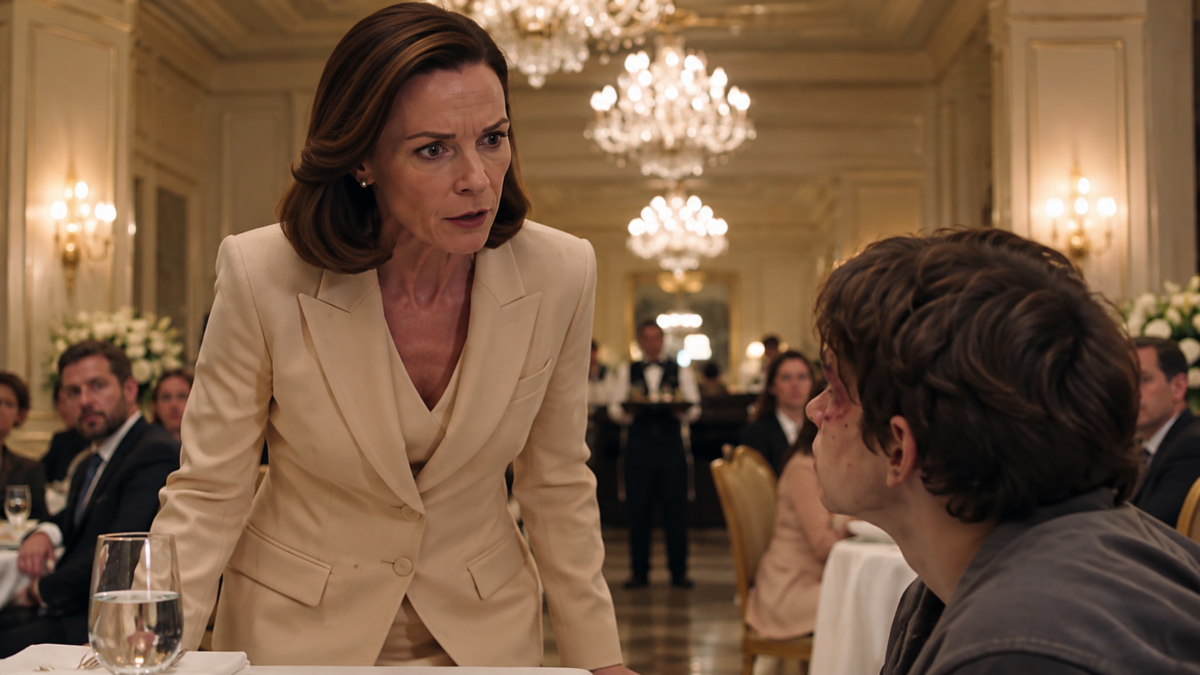
The moment Margaret saw the little boy’s birthmark, her entire world stopped.
Only seconds earlier, she had been shouting at him.
“GET HIM OUT OF MY RESTAURANT!”
Now she stood frozen, staring at the small, reddish, teardrop-shaped mark beside his left eye.
It was impossible.
Eight years had passed.
Eight years of unanswered questions, sleepless nights, and a photograph she kept beneath her pillow.
Yet that mark was exactly where it had been on her missing son’s face.
That afternoon, twelve-year-old Oliver had entered the luxurious restaurant through the back entrance.
His clothes were torn. His dark hair was tangled, his cheeks were covered in dirt, and a purple bruise surrounded his left eye.
He had not eaten since the previous morning.
A ten-year-old boy named Noah, who helped his uncle at the restaurant after school, found him sitting beside the kitchen door.
“Are you hungry?” Noah asked.
Oliver nodded without speaking.
Noah brought him inside and placed a plate of spaghetti in front of him.
“Here. You can eat this.”
Oliver stared at the food.
“Is it really for me?”
“Of course.”
But before Oliver could lift his fork, Margaret, the restaurant’s wealthy owner, appeared.
“What is going on here?”
Her voice made both boys jump.
She looked at Oliver’s dirty face and ragged clothes.
“Why are you feeding this filthy beggar?”
Noah stepped forward.
“Please, ma’am. He’s just hungry.”
Margaret pointed toward the door.
“Get him out!”
Noah’s eyes filled with tears.
“He has nowhere else to go!”
Oliver slowly raised his head.
And that was when Margaret saw it.
The birthmark.
Her anger vanished.
She stepped closer.
“That birthmark…”
Her lips began trembling.
“No… it can’t be!”
Tears rolled down her cheeks.
Oliver watched her fearfully.
“Did I do something wrong, ma’am?”
Margaret could barely breathe.
“What… what’s your name?”
“Oliver.”
The woman staggered backward.
That had been her son’s name.
Eight years earlier, Margaret had taken her four-year-old son to a crowded seaside festival.
Her husband, Thomas, had died the previous winter, leaving her alone with their little boy.
Oliver was everything she had left.
That afternoon, she had turned away for less than a minute to answer a phone call.
When she looked back, her son was gone.
Police searched the festival grounds. Divers examined the nearby harbor. Investigators checked hundreds of reports.
Nothing.
After two years, the official investigation slowed.
Friends encouraged Margaret to accept that Oliver might never return.
But she never stopped searching.
She hired private investigators, funded missing-children charities, and kept her son’s bedroom exactly as it had been.
And now, a starving boy was sitting in her restaurant with the same name and birthmark.
Margaret knelt beside him.
“Oliver… do you remember your mother?”
The boy looked down.
“I don’t remember much.”
“Do you remember the sea?”
He hesitated.
“Sometimes I dream about a beach.”
Margaret covered her mouth.
“And a little blue boat?”
Oliver suddenly looked up.
“How do you know about the boat?”
Margaret began sobbing.
Before he disappeared, Oliver had carried a small blue toy boat everywhere.
It had been his father’s final birthday gift.
Margaret wanted to embrace the boy immediately.
But Oliver recoiled when she reached toward him.
“Please don’t hit me.”
Those words pierced her heart.
She lowered her hands.
“I won’t hurt you. I promise.”
Noah approached and gently took Oliver’s arm.
“He’s frightened,” Noah whispered. “Someone hurt him.”
Margaret noticed the bruising around Oliver’s eye.
“Who did this to you?”
Oliver shook his head.
“I shouldn’t tell.”
Margaret called a doctor and contacted the police and child protection services.
Oliver was given food, clean clothes, and a safe place to rest.
That evening, an investigator spoke with him.
His story was heartbreaking.
He remembered being taken away from a crowded place by a man who promised to help him find his mother.
The man had called himself Uncle Peter.
For years, Oliver had lived in different towns, often sleeping in abandoned buildings.
Peter forced him to beg and took whatever money he collected.
When Oliver was old enough to resist, the man became violent.
Three nights earlier, Oliver had escaped.
He had walked for miles, hiding from strangers because he believed Peter would find him.
By the time he reached Margaret’s restaurant, he was exhausted and terrified.
Margaret listened from the next room, crying silently.
She had imagined her son safe somewhere, perhaps adopted by a kind family.
She had never imagined this.
The next morning, a doctor collected samples for a DNA comparison.
Margaret waited through the following days with her heart in her throat.
Oliver stayed in temporary protective care, where she was allowed supervised visits.
She brought books, drawing pencils, and a small stuffed bear.
She never pressured him to call her Mother.
One afternoon, Oliver asked:
“Why do you keep visiting me?”
Margaret sat beside him.
“Because I think I lost you a long time ago.”
Oliver touched his birthmark.
“Because of this?”
“Partly.”
She showed him a photograph.
A smiling four-year-old boy stood beside a woman on a beach.
He was holding a blue toy boat.
Oliver stared at the picture.
Then his fingers began shaking.
“I remember that woman.”
Margaret’s eyes filled with tears.
“Do you?”
“She used to sing when I couldn’t sleep.”
Margaret whispered the first line of the lullaby she had sung every night.
Oliver continued the melody.
Neither of them could finish.
They simply cried.
Four days later, the DNA results arrived.
Margaret opened the envelope with trembling hands.
The report confirmed a biological parent-child relationship with overwhelming certainty.
Oliver was her son.
She pressed the paper against her chest and collapsed into a chair.
For eight years, she had searched the world.
And her son had walked into her restaurant wearing torn clothes, begging for something to eat.
When Margaret told Oliver the news, he was silent for a long time.
Then he asked a question that nearly broke her.
“If you’re my mother… why didn’t you come for me?”
Margaret knelt before him.
“I tried, sweetheart. I searched every day. I never stopped loving you.”
Oliver looked into her eyes.
“Did you think I was dead?”
“Sometimes I was afraid you were.”
She gently touched his hand.
“But I never stopped hoping.”
Slowly, Oliver leaned forward.
“Can I hug you?”
Margaret wrapped her arms around him.
And for the first time in eight years, she held her son again.
Police eventually identified Peter through the information Oliver provided.
He was arrested and faced charges connected to the boy’s abduction, exploitation, and abuse.
But Oliver’s recovery was not immediate.
He woke from nightmares, hid pieces of bread beneath his pillow, and panicked whenever someone raised their voice.
Margaret arranged trauma-informed counseling and spent months rebuilding his trust.
She also apologized for what she had done in the restaurant.
“I was cruel to you before I knew who you were.”
Oliver looked confused.
“Would you have helped me if I wasn’t your son?”
Margaret could not answer immediately.
Then she told him the truth.
“I don’t know. And that is something I must change.”
She began by changing the restaurant.
No hungry child would be turned away.
Working with local charities, Margaret opened a small dining room where families in need could receive free meals.
She named it Oliver’s Table.
Noah became the first volunteer.
One year later, Oliver walked into the restaurant wearing a clean blue sweater.
His hair was neatly combed, and the bruises had disappeared.
Only the little birthmark beside his eye remained.
He saw Noah serving food to a frightened young boy.
Oliver approached.
“Are you hungry?” he asked gently.
The child nodded.
Oliver placed a warm plate before him.
“Here. You can eat this.”
Margaret watched from the doorway.
Her eyes filled with tears again.
Oliver turned toward her.
“Mom?”
She smiled.
“Yes, sweetheart?”
“Do you remember the day you found me?”
Margaret nodded.
“I remember everything.”
Oliver looked at Noah.
“Then we should thank him. He’s the one who gave me food when nobody else would.”
Margaret embraced both boys.
“You’re right.”
That evening, she placed a small photograph above the restaurant entrance.
It showed Oliver and Noah standing together beside a plate of spaghetti.
Underneath were the words:
“KINDNESS SHOULD NEVER DEPEND ON WHO SOMEONE TURNS OUT TO BE.”
Margaret had once believed her greatest miracle was discovering that a homeless child was her missing son.
But she eventually understood something even greater.
The boy she had tried to throw away was the very person she had spent eight years praying to find.
And the kindness of one little boy, Noah, had brought a broken family together again.
THE END.