Emily Carter was twenty-four years old, with long chestnut-brown hair, gentle eyes, and a quiet smile.
She wore a simple cream-colored cotton dress and an old pair of beige flats.
To anyone passing her on the street, she looked like an ordinary young woman who could barely afford expensive clothes.
But appearances can be dangerously misleading.
That afternoon, Emily entered one of the most luxurious handbag stores in London.
Crystal chandeliers hung from the ceiling. Designer handbags sparkled behind glass displays, and wealthy customers wandered between the shelves.
Emily stopped in front of a beautiful brown leather handbag.
She touched it gently.
It reminded her of something her mother had owned many years ago.
“Can I help you?”
Emily turned around.
A woman in a black blazer and pencil skirt was approaching.
Her name was Victoria Bennett, the thirty-eight-year-old store manager.
Victoria examined Emily from head to toe.
Her smile immediately disappeared.
“Are you looking for someone?”
Emily answered politely.
“No, thank you. I’d just like to see this handbag.”
Victoria looked at her faded shoes.
“Do you know how much that bag costs?”
Emily nodded.
“I’d like to take a closer look.”
Victoria crossed her arms.
“I’m afraid we don’t allow people to touch merchandise they can’t afford.”
Emily frowned.
“Excuse me?”
“You heard me.”
Several customers turned toward them.
Emily remained calm.
“You don’t know what I can afford.”
Victoria laughed.
“Sweetheart, I’ve worked in luxury retail for fifteen years. I know exactly who belongs here.”
She pointed toward the entrance.
“Now leave before you embarrass yourself.”
Emily took a deep breath.
“I haven’t done anything wrong.”
Victoria’s expression hardened.
“Are you refusing to leave?”
“I only asked to see a handbag.”
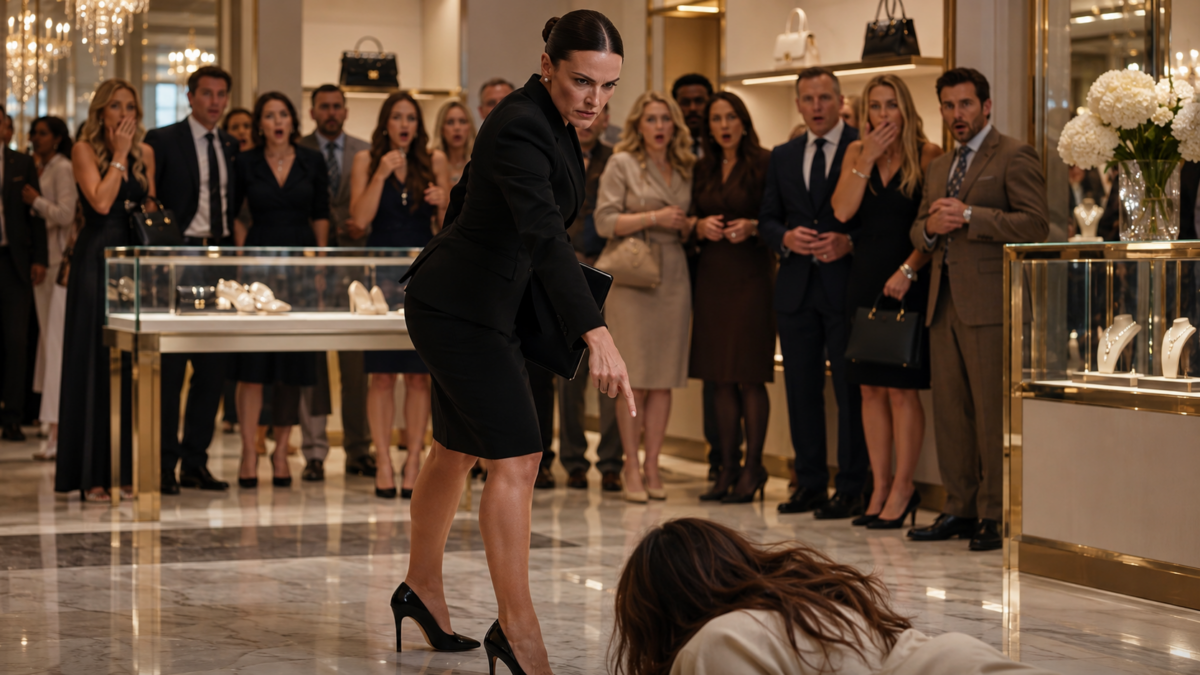
Suddenly, Victoria stepped forward and shoved Emily.
The young woman lost her balance and fell onto the polished marble floor.
THUMP!
A gasp swept through the store.
Emily stared at the manager in disbelief.
Her elbow hurt, and her cream dress was covered with dust.
Victoria looked down at her.
“GET OUT! PEOPLE LIKE YOU DON’T BELONG HERE!”
Emily slowly pushed herself upright.
“I haven’t done anything wrong!”
“I SAID GET OUT! NOW!”
Nearby, a woman covered her mouth in shock.
A young man reached for his phone.
But no employee dared intervene.
Everyone knew Victoria had a reputation for firing staff who challenged her.
Emily brushed the dust from her dress.
She looked at Victoria quietly.
“Are you sure you want to treat a customer this way?”
Victoria laughed.
“What are you going to do? Complain to the owner?”
Emily didn’t answer.
Instead, she took out her phone and sent a short message.
I’m ready. Please come to the entrance.
Victoria rolled her eyes.
“Oh, please. Who do you think you are?”
At that exact moment, a black Mercedes G-Class stopped outside the store.
The driver stepped out.
He was a tall, broad-shouldered man wearing a perfectly tailored black suit and dark sunglasses.
He walked directly through the entrance.
Victoria immediately straightened her blazer.
She assumed an important customer had arrived.
“Good afternoon, sir! Welcome to—”
But the man walked past her.
He stopped in front of Emily.
Then he lowered his head respectfully.
“GOOD AFTERNOON, MA’AM. YOUR CAR IS READY.”
Victoria froze.
Her mouth fell open.
“Ma’am?”
The bodyguard turned toward her.
“Is there a problem here?”
Emily looked at the manager.
“Yes, James. There is.”
Victoria suddenly forced a smile.
“Oh! I believe there’s been a misunderstanding.”
Emily raised an eyebrow.
“A misunderstanding?”
Victoria laughed nervously.
“I didn’t realize you were accompanied by private security.”
Emily looked at James.
“Please ask the store’s regional director to come here.”
James nodded.
“Immediately, ma’am.”
Victoria felt a wave of panic.
“Wait! There’s no need to involve anyone else!”
Emily calmly sat on a nearby chair.
“Why not? You were perfectly comfortable humiliating me in front of everyone.”
Victoria swallowed.
Ten minutes later, a gray-haired man hurried into the store.
His name was Jonathan Reed, the regional director.
The moment he saw Emily, his face changed.
“Miss Carter!”
He approached her quickly.
“We weren’t expecting you until tomorrow!”
Victoria stared at them.
“Mr. Reed… you know her?”
Jonathan looked surprised.
“Of course.”
He turned toward Emily.
“Miss Carter, I’m terribly sorry. Has something happened?”
Emily pointed to the marble floor.
“Your manager pushed me because she didn’t like my clothes.”
Jonathan’s smile disappeared.
Victoria began shaking.
“That’s not what happened!”
Emily glanced toward the security cameras.
“Then perhaps we should review the footage.”
Jonathan immediately requested the recording.
A few minutes later, everyone watched Victoria shove Emily to the floor.
The evidence was unmistakable.
Jonathan turned toward the manager.
“Victoria, explain yourself.”
She stammered.
“I thought she was causing trouble…”
“By asking to look at a handbag?”
Victoria lowered her head.
Then Jonathan revealed something that made her knees weaken.
“Victoria, Miss Carter is the new majority owner of this entire retail group.”
The store fell silent.
Emily looked at the manager.
“My family acquired the company last month.”
Victoria’s face turned white.
“You… you’re the owner?”
Emily nodded.
“Yes.”
Victoria began crying.
“Please forgive me! I had no idea!”
Emily’s expression remained serious.
“And that’s exactly the problem.”
She stood up.
“You think people deserve respect only when they have money or power.”
Victoria wiped her tears.
“I made a terrible mistake.”
Emily replied softly:
“You didn’t make a mistake about my identity. You made a choice about how to treat someone you believed was poor.”
Jonathan turned to Emily.
“What would you like us to do?”
Emily looked around the store.
Several employees were watching nervously.
She noticed a young sales assistant standing near the entrance.
The girl had tears in her eyes.
Emily approached her.
“What’s your name?”
“Sarah, ma’am.”
“How long have you worked here?”
“Eight months.”
Emily lowered her voice.
“Has this happened before?”
Sarah hesitated.
Victoria glared at her.
But Emily spoke gently.
“You won’t be punished for telling the truth.”
Sarah took a deep breath.
“Yes. She regularly insults customers who aren’t dressed expensively.”
Other employees slowly nodded.
Sarah continued.
“Last week, she made an elderly woman leave because the woman wanted to buy a gift with her savings.”
Emily felt her heart sink.
Jonathan looked furious.
He asked Victoria to leave the sales floor while the incident was formally reviewed.
The investigation confirmed repeated misconduct, and Victoria was dismissed in accordance with the company’s procedures.
But Emily wasn’t finished.
She gathered the employees together.
“From today onward, I want this company to follow one simple principle.”
Everyone listened.
“No customer should ever have to prove their wealth before receiving basic kindness.”
She looked at Sarah.
“And no employee should fear losing their job for defending someone’s dignity.”
A week later, Emily returned to the store.
This time, she wore the same cream dress.
But something had changed.
The employees welcomed every visitor warmly, regardless of how they looked.
Sarah had been appointed acting store supervisor while the company selected a new manager.
Emily approached the brown leather handbag she had admired.
“Would you like to see it?” Sarah asked.
Emily smiled.
“Yes, please.”
Sarah carefully placed it on the counter.
Emily ran her fingers over the leather.
“My mother had a bag just like this.”
Sarah smiled.
“She must have had lovely taste.”
Emily’s eyes softened.
“She did.”
Her mother had once worked as a cleaner in luxury hotels.
When Emily was little, she often accompanied her mother to work.
She remembered wealthy guests who walked past them without even saying hello.
One day, a guest had accused her mother of stealing a bracelet.
The bracelet was later found in the guest’s own luggage.
But nobody apologized.
Emily had never forgotten her mother’s humiliation.
Years later, her mother married a kind businessman who helped Emily pursue her education.
Emily eventually built her own career in investment management.
Even after inheriting shares in the family business, she continued wearing simple clothes.
They reminded her of where she came from.
And they reminded her never to judge someone by their appearance.
Three months later, Emily launched a new company program called “Dignity First.”
Every store employee received training in respectful customer service.
Workers could report bullying without fear of retaliation.
Emily also established scholarships for young people from low-income families who wanted careers in fashion and retail.
Sarah became one of the program’s first ambassadors.
At the launch ceremony, a journalist asked Emily:
“Why did you personally visit that store without telling anyone who you were?”
Emily smiled.
“Because customers shouldn’t have to announce their importance to be treated kindly.”
The journalist continued:
“Did you want revenge on the manager?”
Emily shook her head.
“No. I wanted to make sure nobody else experienced what I did.”
Then she added:
“Power is most valuable when we use it to protect people who have less of it.”
The audience applauded.
Six months later, Emily received an unexpected letter.
It was from Victoria.
Dear Miss Carter,
I don’t expect you to forgive me.
Losing my position forced me to confront something I had ignored for years: I had become cruel.
I treated people as if their clothes determined their value.
I have started again in a smaller store, and I’m trying to become a better person.
I’m sorry for humiliating you.
Victoria.
Emily read the letter twice.
Then she placed it in her desk.
She didn’t know whether Victoria had truly changed.
But she hoped the woman would continue learning.
That evening, Emily visited her mother’s grave.
She placed white roses beside the headstone.
“Mom,” she whispered, “I finally did something I think you’d be proud of.”
A gentle breeze moved through the trees.
Emily smiled through her tears.
She remembered something her mother used to tell her:
“Never be ashamed of simple clothes, sweetheart. Be ashamed only if you forget how to be kind.”
Emily touched the fabric of her cream dress.
Then she stood and walked toward the waiting Mercedes.
James opened the door.
“Ready to go, ma’am?”
Emily smiled.
“Yes, James. Let’s go home.”
Victoria had believed she was humiliating a poor, powerless girl.
She never imagined the girl owned the entire luxury retail group.
But Emily’s greatest victory wasn’t revealing her wealth or dismissing a cruel manager.
It was changing a company so that the next girl in a simple cotton dress would be welcomed with the same respect as a millionaire.
Because true elegance isn’t measured by expensive handbags, designer clothes, or luxury cars.
It’s measured by the way we treat people who can do nothing for us.
THE END.